How to Cook Frozen Crab Legs by Steaming, Boiling or Baking
Crab legs come precooked, so you’re reheating them: steam over boiling water for six to ten minutes per Alaskan King Crab Co., boil briefly until hot, or bake at 350°F to 145°F.
Why Frozen Crab Legs Are Already Cooked (And What You’re Really Doing)
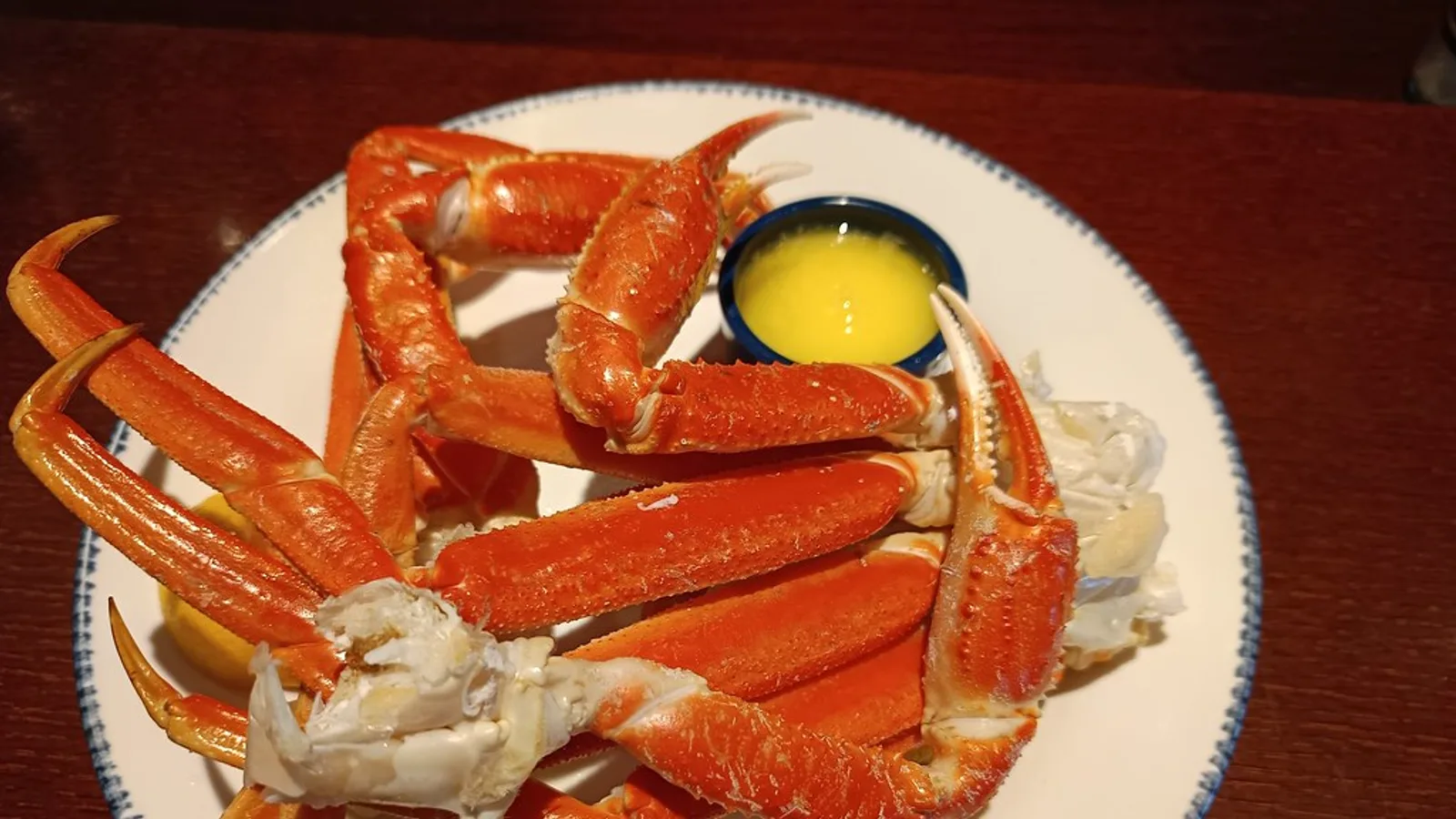
Nearly every crab leg in a US supermarket freezer case was boiled or steamed on the boat or at a dockside processor, then blast-frozen within hours of the catch. The meat inside that shell is fully cooked. You could eat it cold, straight from a thawed cluster, with lemon and nothing else.
That changes how you think about timing. A chicken thigh forgives an extra five minutes in the oven; a snow crab cluster does not. Heat it past the point where the meat is hot through and the muscle fibers tighten, water leaves, and you end up with salty strands that cling to the shell instead of sliding out in one piece.
Freezer dates confuse people for the same reason. According to FoodSafety.gov’s Cold Food Storage Chart, food held continuously frozen at 0°F (-18°C) or below stays safe indefinitely, which means any date on crab packaging speaks to quality rather than safety.
What degrades over months is texture and aroma, not safety. Ice crystals rupture cells, the glaze sublimates, and the edges of the meat dry into something cottony. Buy crab you’ll cook within a few months and keep the freezer closed.
What You Need Before You Start: Gear, Portions and Buying Notes
You need less equipment than you think. A large stockpot with a lid, a steamer basket or a metal colander that sits above the water line, long tongs, and an instant-read thermometer cover every method in this guide. Kitchen shears beat a crab cracker for snow crab, because the shells are thin enough to cut lengthwise in one pass.
For portions, plan on about a pound to a pound and a half of legs per adult eating crab as the main course, and closer to half a pound if you’re serving it alongside steak or pasta. Shell weight is most of what you’re buying.
Supply is healthier than it was a few seasons ago. The Cordova Times reported that the Bering Sea snow crab fleet was allocated 9.3 million pounds for the 2025-2026 season, up from 4.72 million pounds the previous year. The same report noted Bristol Bay red king crab opened October 15 with a total allowable catch of 2.680 million pounds, up from 2.31 million pounds in 2024-2025.
At the counter, look for legs with intact shells, minimal white frost, and no sour smell when the bag is opened. Snow crab clusters cook fastest and crack easiest. King crab legs are thicker, meatier and need more time in the steam.
Step 1 — Decide Whether to Thaw or Cook From Frozen
Time: 8-12 hours in the refrigerator, or roughly 30 minutes in cold water.
Thawing first gives you more even heating and shorter cook times, which matters most with thick king crab legs where the outside overcooks while the center is still cold. Set the clusters on a rimmed sheet pan or in a colander over a bowl, cover loosely, and leave them in the refrigerator overnight.
Do not thaw crab on the counter. FoodSafety.gov warns that bacteria causing illness multiply quickly between 40°F (4°C) and 140°F (60°C), which is exactly the window a package of crab passes through as it sits on a warm kitchen surface.
When you need crab on the table tonight, use the cold-water method. USDA Food Safety and Inspection Service says that when thawing food in cold water you must submerge it in a leak-proof bag and change the water every 30 minutes, then cook it immediately.
Cooking from frozen is legitimate and often the better call for snow crab. Add a few minutes to whichever method you choose, pat off the surface ice first so the pot doesn’t lose its boil, and expect a slightly wetter result.
Step 2 — Steam Crab Legs (The Default Method)
Time: about 6-10 minutes. You need a stockpot, a lid, a basket or colander, and tongs.
Steam is the method to use if you only learn one. The legs never sit in water, so the brine-sweet flavor stays in the meat instead of leaching into the pot, and the shells come out glossy rather than waterlogged.
Pour an inch or two of water into the pot, bring it to a hard boil, then set the basket above the water line and pile in the clusters. Alaskan King Crab Co. instructs home cooks to steam legs over boiling water, covered, for six to ten minutes until heated through. Keep the lid on; every peek costs you steam.
Size drives the clock. Intershell Seafood specifies steaming times of about 4 to 5 minutes for snow crab legs and 6 to 8 minutes for thicker king crab legs.
Working straight from the freezer takes longer. FreshSeafood.com recommends steaming crab legs straight from frozen for about ten minutes, using 2 cups of water and 1 tablespoon of salt brought to a boil.
Steam in a single layer if the pot allows it, or stack no more than two deep and rotate the clusters halfway through with tongs.
Step 3 — Boil Crab Legs When You’re Feeding a Crowd
Time: roughly 5-10 minutes of simmering. You need your largest pot and a spider or tongs.
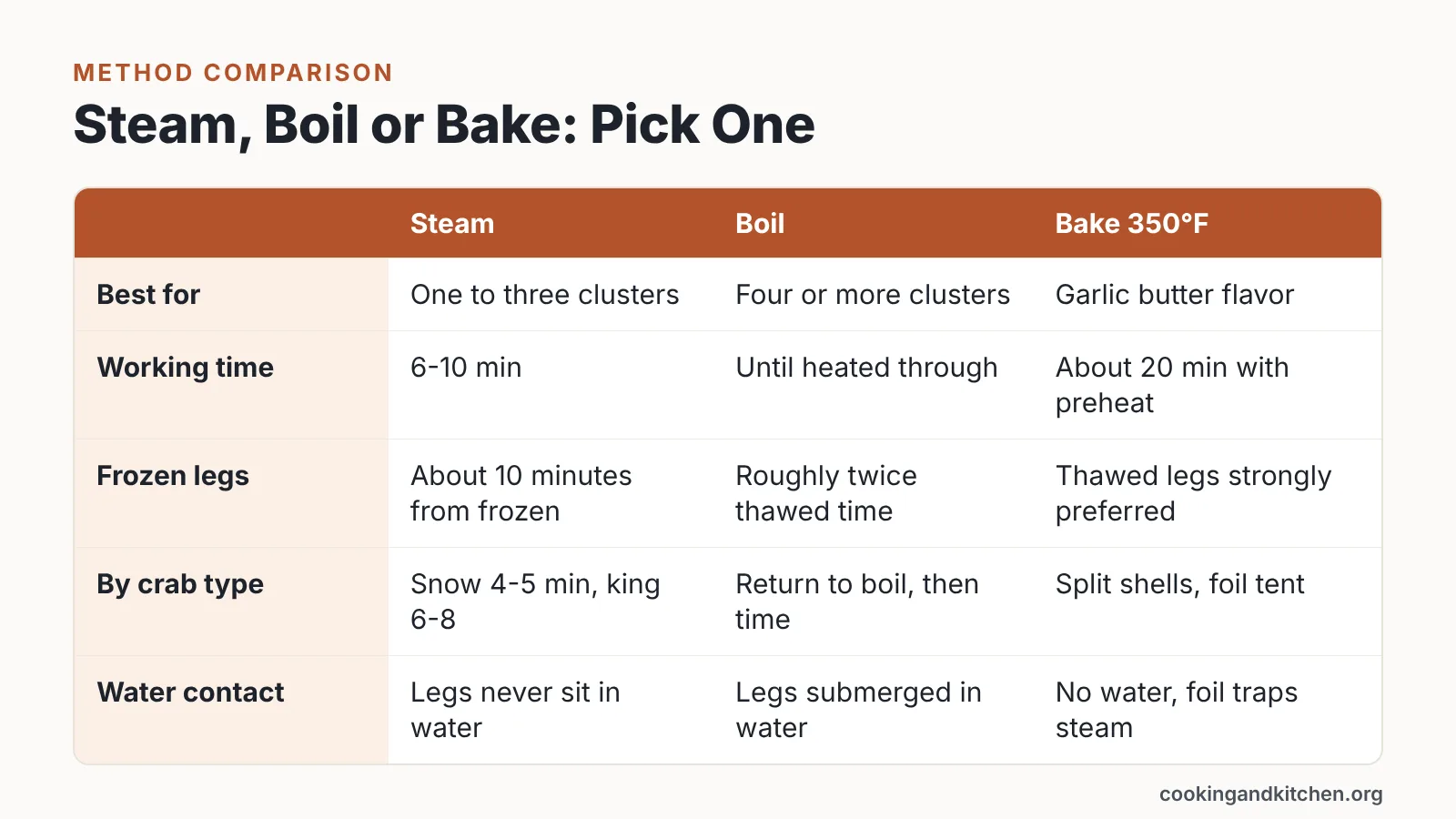
Boiling wins on volume. A 12-quart stockpot swallows four to six clusters at once, and because the water carries heat faster than steam does, the legs come back up to temperature quickly even straight from frozen.
Fill the pot two-thirds full, bring it to a rolling boil, and salt it lightly if at all. Crab is already brined from processing, and heavily salted water pushes the meat toward jerky territory. A halved lemon, a few bay leaves or a spoonful of seafood seasoning in the water adds aroma without doing much harm.
Slide the clusters in and wait for the water to return to a boil before you start timing. Thawed legs usually need only a few minutes once the boil comes back; frozen clusters want roughly twice that. Pull one out and twist a leg open to check rather than trusting the clock.
Drain the legs in a colander and let them stand a minute so the shells shed water. Serve them on a warmed platter, not a cold one.
Step 4 — Bake Crab Legs at 350°F for Butter-Basted Flavor
Time: about 20 minutes including preheat. You need a sheet pan, foil, butter and garlic.
The oven gives you flavor the pot can’t. Melted butter, minced garlic and lemon zest pool inside the split shells and season the meat directly instead of washing over it.
Alaskan King Crab Co. directs cooks to preheat to 350 degrees Fahrenheit before baking the legs. Arrange the clusters on a foil-lined sheet pan, brush or spoon the butter mixture over them, then tent the whole pan loosely with a second sheet of foil so the trapped steam does the heating.
Thawed legs are strongly preferred here, because dry oven heat is less forgiving than wet heat and a frozen core drags the surface meat well past done. If you must bake from frozen, add several minutes and keep the foil tent sealed.
For split-shell king crab, skip the top layer of foil for the last two or three minutes and baste once more. The exposed meat picks up a light gloss and the butter concentrates.
Resist broiling. Crab meat has almost no fat to protect it, and the broiler turns the top layer leathery before the rest of the leg is warm.
Step 5 — Check Doneness, Crack and Serve
Time: 5 minutes. You need an instant-read thermometer, shears and a cracker.
Heat is the only doneness cue that matters, since the meat was cooked at the processor. The FDA advises that most seafood should be cooked to an internal temperature of 145°F, the benchmark to check with a thermometer when reheating crab legs.
Slide the probe into the thickest part of the largest leg, through the joint if you can, avoiding the shell wall. Two faster sensory checks back it up: the shells turn bright orange-red and fragrant, and a leg snapped at the knuckle releases a visible puff of steam.
Crack at the table while the legs are hot. Run kitchen shears down the softer underside of each snow crab leg, open it like a book, and lift the meat out whole. King crab shells are tougher; crack at the joints first, then cut along the flat edge.
Serve with drawn butter kept warm but not sizzling, lemon wedges, and a bowl for the shells. Cold butter congeals on the meat and dulls the flavor.
Quick Checklist: Times, Temperatures and Safety Limits at a Glance
Run through these before the pot goes on the burner. Each line is a decision you’d otherwise make mid-cook with butter on your hands.
- Thaw plan chosen — refrigerator overnight, or cold water in a leak-proof bag with the water changed every 30 minutes, per USDA Food Safety and Inspection Service.
- Pot sized correctly — clusters in one or two layers, lid closes fully.
- Water at a hard boil before the crab goes in — not a simmer.
- Steam clock set — 6 to 10 minutes covered, as Alaskan King Crab Co. instructs, or 4 to 5 minutes for snow crab and 6 to 8 for king crab per Intershell Seafood.
- Oven preheated to 350°F before the pan goes in, following Alaskan King Crab Co.
- Thermometer reads 145°F at the thickest joint, the FDA’s seafood benchmark.
- Butter melted, lemons cut, shells bowl on the table before the crab comes off the heat.
- Leftovers refrigerated promptly — FoodSafety.gov warns that seafood should never sit out of the refrigerator for more than 2 hours, or more than 1 hour when the temperature is above 90°F (32°C).
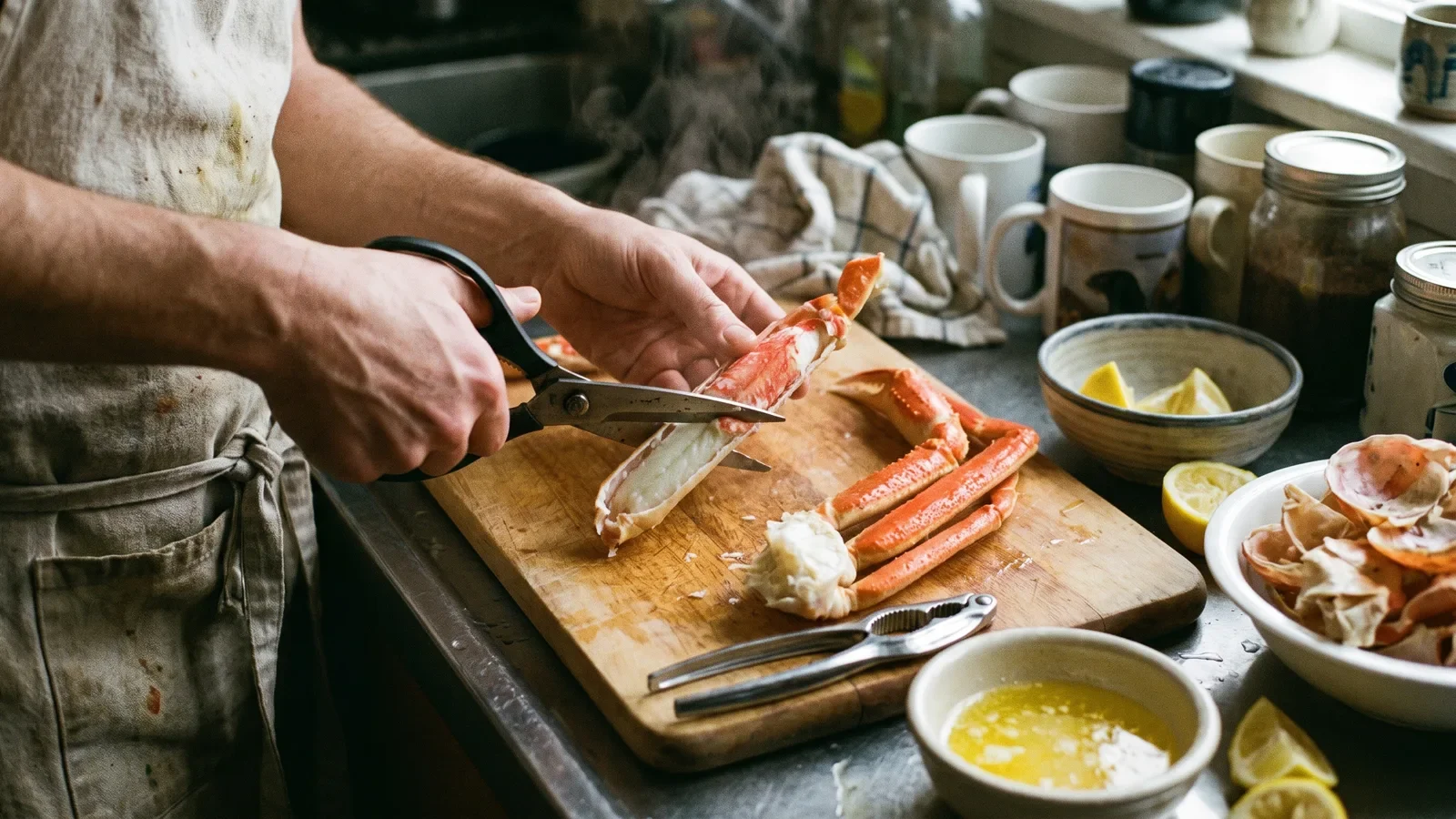
| Method | Best for | Working time |
|---|---|---|
| Steam | One to three clusters, best flavor | 6-10 min (Alaskan King Crab Co.) |
| Boil | Four or more clusters, frozen legs | Until heated through |
| Bake at 350°F | Garlic butter flavor, split shells | About 20 min with preheat |
Common Mistakes That Ruin Frozen Crab Legs
The failure you’re most likely to hit is overcooking, and it comes from treating precooked crab like raw shrimp. Cooks set a fifteen-minute timer on a snow crab cluster that needed four, then wonder why the meat shredded and stuck to the shell. Avoid it by timing short, checking one leg early, and returning the pot to the heat for another minute if the center is still cool — undershooting is recoverable, overshooting is not.
Counter thawing is the second trap, and it’s a safety problem rather than a texture one. FoodSafety.gov warns that seafood should never sit out of the refrigerator for more than 2 hours, or more than 1 hour when the temperature is above 90°F (32°C), which rules out the all-afternoon thaw on the counter.
Heavy salting of the boiling water backfires too. Processors already brine the legs, so a cup of salt in the pot pulls moisture out and leaves the meat tasting cured.
Cracking the shells before heating lets juice escape into the water or the pan, taking flavor with it. Crack after, at the table.
Crowding the steamer is the quiet one. Pack a basket four clusters deep and the top layer stays cold while the bottom overcooks, so work in batches and keep the finished legs under foil on a warm platter.
Frequently asked questions
Can you cook frozen crab legs without thawing them first?
Yes. Cooking from frozen works well for snow crab, and FreshSeafood.com recommends steaming crab legs straight from frozen for about ten minutes, using 2 cups of water and 1 tablespoon of salt brought to a boil. Pat off surface ice first so the pot holds its boil.
What internal temperature should crab legs reach?
The FDA advises that most seafood should be cooked to an internal temperature of 145°F, so slide an instant-read thermometer into the thickest joint of the largest leg. Bright orange shells and a puff of steam when you snap a knuckle are useful secondary cues.
How long do you steam snow crab versus king crab legs?
Thickness drives the clock. Intershell Seafood specifies steaming times of about 4 to 5 minutes for snow crab legs and 6 to 8 minutes for thicker king crab legs, while Alaskan King Crab Co. gives a broader six to ten minute window, covered, over boiling water.
What is the fastest safe way to thaw crab legs?
Use cold water, not the counter. USDA Food Safety and Inspection Service says that when thawing food in cold water you must submerge it in a leak-proof bag and change the water every 30 minutes, then cook it immediately rather than returning it to the refrigerator.
How long can cooked crab legs sit out before serving?
Keep the window short. FoodSafety.gov warns that seafood should never sit out of the refrigerator for more than 2 hours, or more than 1 hour when the temperature is above 90°F (32°C), which covers both the platter on the table and leftovers waiting to be packed up.
Sources
- Selecting and Serving Fresh and Frozen Seafood Safely — U.S. Food and Drug Administration
- Safe Selection and Handling of Fish and Shellfish — FoodSafety.gov
- Keep Food Safe! Food Safety Basics — USDA Food Safety and Inspection Service
- Cold Food Storage Chart — FoodSafety.gov
- Snow crab fishery quota rises to 9.3 million pounds — The Cordova Times
- How to Cook Alaskan King Crab Legs — Alaskan King Crab Co.
- How to cook king crab legs in the oven — Alaskan King Crab Co.
- How to Cook Crab Legs: Steam, Boil, Bake and Grill — Intershell Seafood
- How to Cook Frozen King Crab Legs — FreshSeafood.com
AI tools helped write this guide. The Cooking and Kitchen Editorial Team published it after checking every figure against the sources linked above.
Related articles

Cooking and Kitchen Editorial Team
Articles on Cooking and Kitchen are written by the editorial team with AI assistance and checked against the cited sources.


You May Also Like
How to Cook Dried Beans on the Stove or in a Pressure Cooker
How to Cook Oyster Mushrooms So They Crisp, Not Steam