Meal Prep Ideas for the Week That Last to Friday
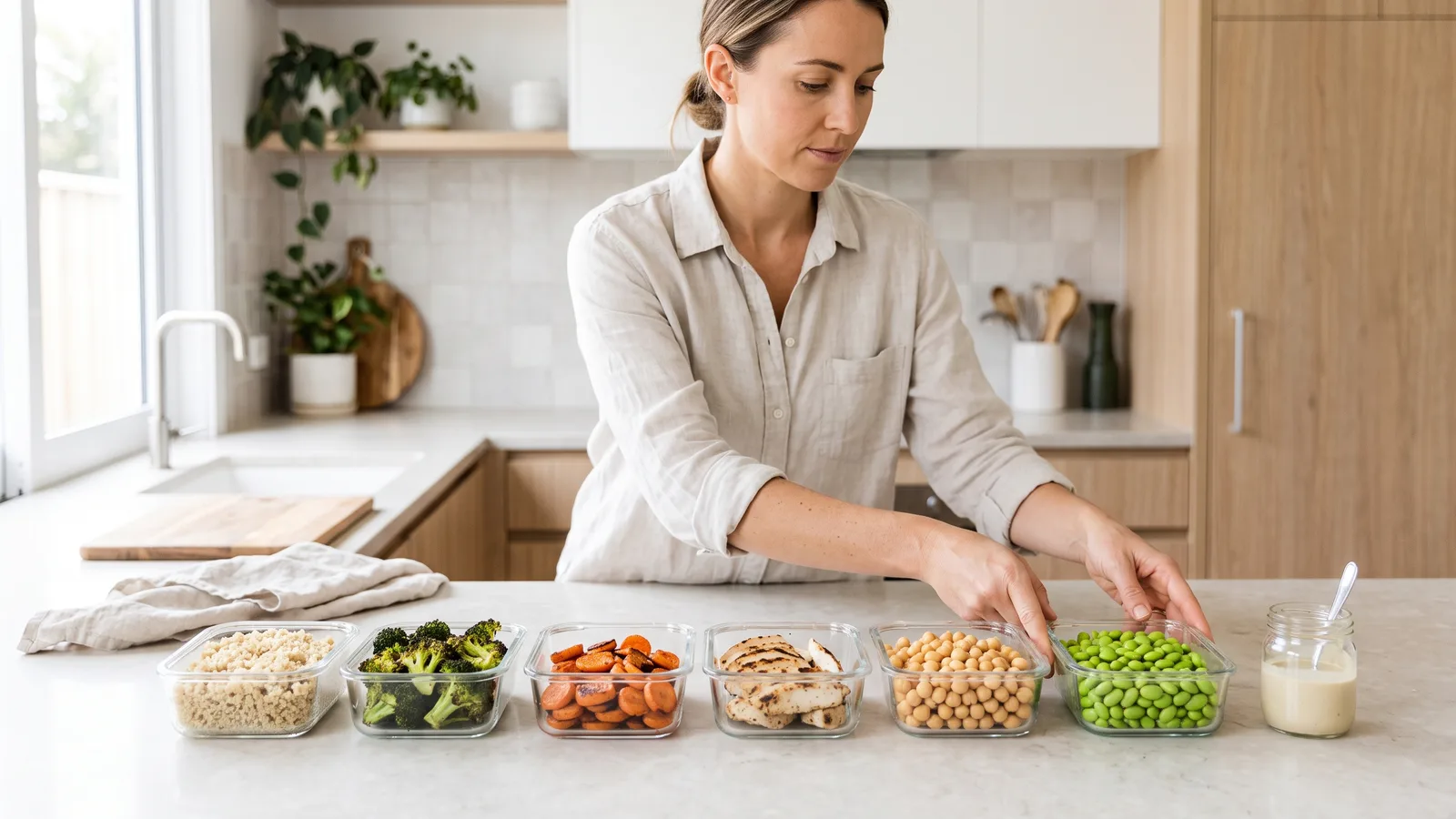
The meal prep ideas for the week that survive to Friday are component-based: cook four building blocks, chill them fast in shallow containers, label the cook date, and freeze the last two days’ portions on Sunday night.
Quick steps for a week that holds
Five moves decide whether Friday’s lunch tastes like food or like the back of the fridge.
- Choose four components — one grain, one roasted vegetable, one protein, one sauce — instead of five finished, pre-assembled dinners.
- Move cooked food toward cold quickly: USDA FSIS says perishable food should never sit out of refrigeration for more than 2 hours, or more than 1 hour when the temperature is above 90°F.
- Cool everything in shallow, uncovered containers until the steam stops, then lid them and stack them flat on a middle shelf.
- Label every lid with the dish and the cook date, because USDA FSIS advises eating refrigerated cooked leftovers within 3 to 4 days, either cold or reheated to 165°F.
- Freeze Thursday’s and Friday’s portions on Sunday night, then move them down to the fridge on Wednesday morning.
Each move takes minutes. The order is what matters, far more than which recipes you pick. Run the same five steps next Sunday and the week repeats without new decisions.
The Friday problem: why a Sunday cook-off tastes tired by Wednesday
A finished, sealed meal begins aging the second the lid goes on. Dressing wicks into greens and turns them translucent. Roasted vegetables weep into the grain underneath, rice tightens against the container walls, and a crisp chicken skin goes soft by Tuesday morning.
Texture is only half of it. The other half is the fifth container, the one you look at on Thursday, decide against, and replace with takeout. That container usually ends up in the trash on Saturday.
That quiet attrition is expensive. The FDA estimates US food waste at between 30 and 40 percent of the food supply, drawing on USDA Economic Research Service loss estimates at the retail and consumer levels.
The cure is not better containers. It is keeping flavor and crunch out of the fridge until the moment you eat: sauce in its own jar, herbs and greens added at the table, nuts and pickles stored dry. Build the meal on the day, from parts that were built on Sunday.
The clock you’re actually prepping against: the 3-to-4-day fridge limit, the 2-hour rule, and 40°F
Three limits shape every weekly plan, and none of them are about taste.
| Limit | What it covers | Source |
|---|---|---|
| 2 hours out of the fridge (1 hour above 90°F) | Any perishable cooked or cut food on the counter | USDA FSIS |
| 3 to 4 days in the fridge | Cooked leftovers; also egg, chicken, ham, tuna and macaroni salads | USDA FSIS; FoodSafety.gov |
| 40°F or below | The temperature your refrigerator must actually hold | FDA |
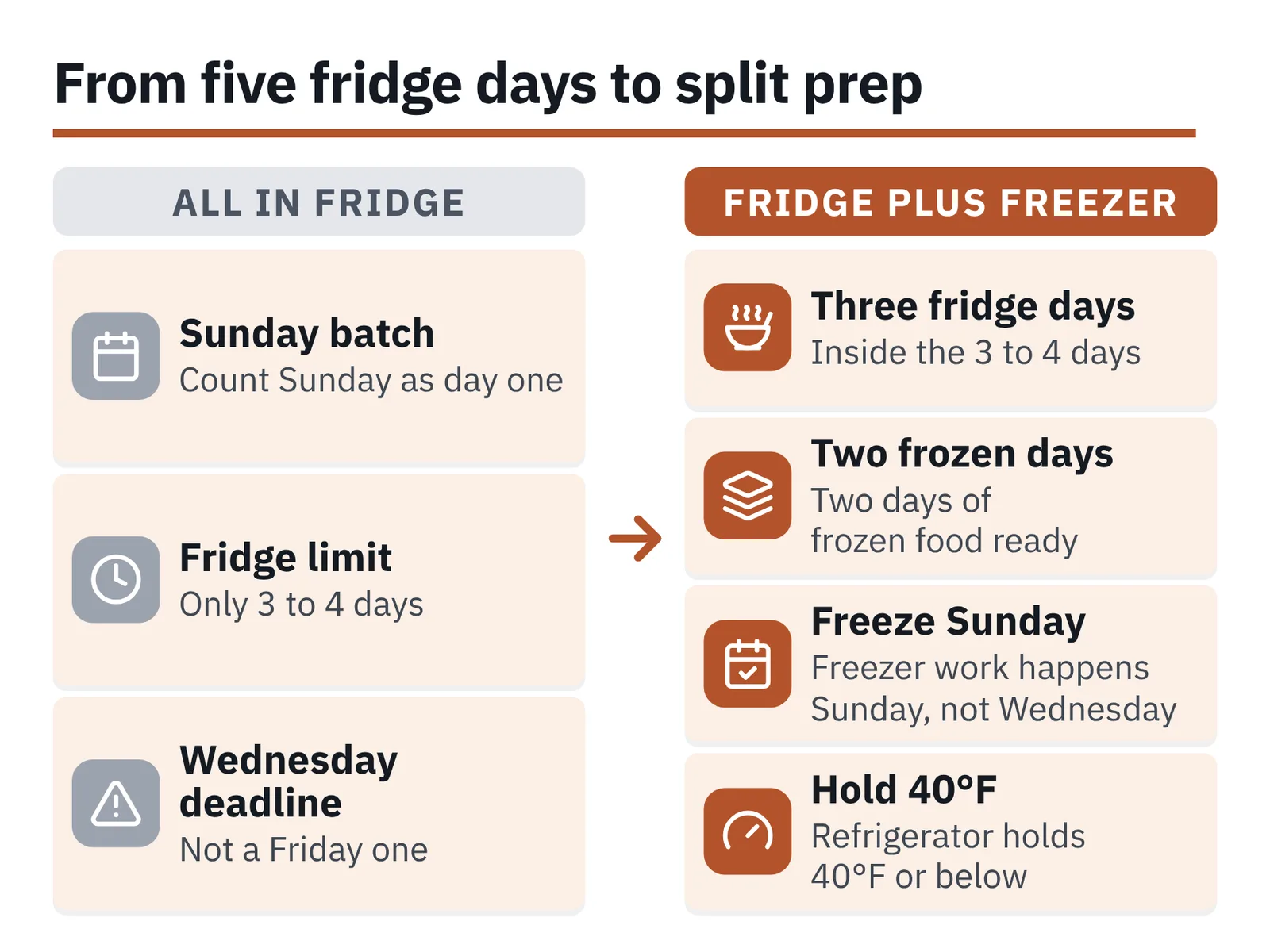
FoodSafety.gov’s Cold Food Storage Chart gives prepped egg, chicken, ham, tuna and macaroni salads a refrigerator life of only 3 to 4 days. Count Sunday as day one and the math is blunt: a Sunday batch is a Wednesday deadline, not a Friday one.
That single fact rewrites the whole plan. You are not prepping five days of refrigerated food. You are prepping three days of refrigerated food plus two days of frozen food, and the freezer work happens Sunday, not Wednesday when you have already lost interest.
Example: Priya’s week, Sunday dinner through Friday lunch
Example: Priya cooks for herself and one partner, works Tuesday and Thursday in an office, and wants lunch handled through Friday.
Sunday afternoon she cooks four things: a pot of farro, two sheet pans of broccoli and carrots, chicken thighs, and a jar of lemon-tahini sauce. A fifth element, quick-pickled red onions, lives in a small jar and gets better all week. Dinner that night is those parts, hot, on plates.
Monday and Tuesday lunches are farro bowls built from the fridge in four minutes. Wednesday evening she turns the last of the chicken and vegetables into a skillet dish with the pickles and a fried egg, which clears the 3-to-4-day window with a day to spare.
Thursday and Friday run on the two portions she froze on Sunday night, moved to the fridge Wednesday morning. Greens, herbs and sauce go on at the table, never in the container. Breakfast is a jar of oats; if you want it to set properly overnight, the method in this guide to cooking oatmeal that turns out creamy every time applies to the cold version too.
Before and after: the cook-five-finished-meals marathon vs. the split-batch workflow
The marathon version looks productive. Five identical containers, each holding a complete dinner, assembled hot and sealed hot, stacked two deep so the ones at the back cool slowly and get forgotten. By Wednesday the rice has gone chalky, the sauce has soaked everything, and the last two meals are a chore.
The split-batch version produces the same number of lunches from the same shopping list. The difference is that nothing is assembled in advance: grains in one flat container, roasted vegetables in another, protein in a third, sauce in a jar, crunchy things dry in a bag.
Freshness is the real before-and-after. In the marathon version, the fifth meal is four days old and tastes it. In the split-batch version, the fifth meal is assembled Friday morning from frozen-on-Sunday protein, grain that was frozen flat, and greens bought fresh — so it is minutes old when you eat it.
Variety comes free. The same farro, broccoli and chicken become a grain bowl, a wrap and a skillet hash depending on which sauce and which crunch you reach for.
The reproducible Sunday procedure: a six-step, two-hour session
Run these six steps in this order every week and the session stops requiring planning.
- Minute 0 — heat first. Oven to 425°F, water on for the grain, meat out and seasoned. Nothing waits on an appliance later.
- Minute 10 — vegetables in. Two sheet pans, cut to similar sizes, no crowding, so they roast instead of steaming.
- Minute 25 — protein in or on. Thighs, tofu, a pot of beans. Dried beans are the cheapest component in the lineup; this walkthrough of cooking dried beans on the stove or in a pressure cooker gives you timings for both.
- Minute 40 — sauce and acid. Blend or shake one sauce and one pickle while the oven works. These carry the whole week’s flavor.
- Minute 60 — spread and cool. Everything into shallow containers, uncovered, in a single layer. The professional cooling standard in the FDA Food Code, as published by the Minnesota Department of Health, requires cooked time/temperature-control-for-safety food to drop from 135°F to 70°F within 2 hours and to 41°F or below within 6 hours total.
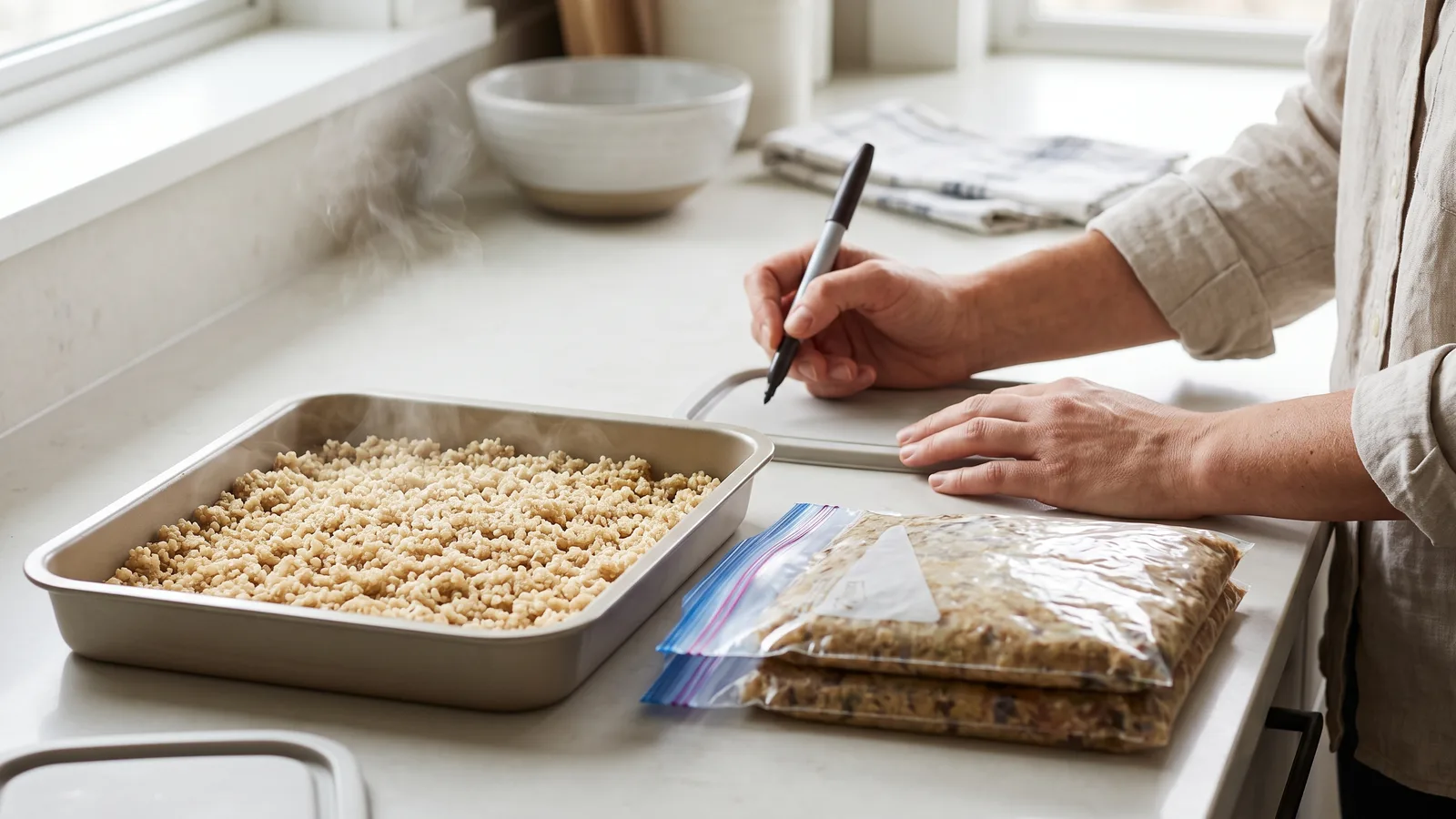
- Minute 90 — portion, label, split. Lid and date everything, then send two portions straight to the freezer before you sit down.
Step six is the one people skip. It is also the only reason Friday works.
Build-a-bowl components that survive to Friday (and the three that never do)
Components that hold
Cooked grains stored flat and reheated with a splash of water. Roasted root vegetables, squash and broccoli. Braised or poached chicken, pork and beans in a little of their liquid. Hard-cooked eggs in the shell. Vinaigrettes, tahini sauces and salsas in jars. Quick pickles, which improve. Toasted nuts and seeds kept dry at room temperature.
The three that never do
- Cooked rice held for days. The UK Food Standards Agency advises keeping cooked rice in the fridge for no more than one day and eating it within 24 hours, because Bacillus cereus spores survive cooking.
- Dressed greens and cut herbs. Salt and acid collapse the cell walls within hours; store leaves dry and dress at the table.
- Anything fried or breaded. Crisp coatings go leathery in a sealed container, and no reheat brings them back.
Frozen vegetables deserve a spot in the rotation for exactly this reason — they wait in the freezer instead of aging in the fridge. The technique in this guide to cooking frozen broccoli without the mush keeps a Thursday side from turning gray.
Chill fast, store flat, label everything
Speed of cooling is the lever that buys you the back half of the week. The FDA says bacteria that cause foodborne illness can double every 20 minutes at room temperature, which is why cooked food must be chilled quickly rather than left to come down to room temperature on the stove.
Shallow beats deep. A quart of chili in a wide, 2-inch-deep container chills in a fraction of the time it takes in a tall pot, so spread hot food out, leave it uncovered until the steam stops, then lid it.
Verify the appliance rather than trusting the dial. The FDA recommends using an appliance thermometer to confirm the refrigerator stays at 40°F or below and the freezer at 0°F or below. Put the thermometer on a middle shelf, not in the door.
Label with a dish name and a cook date in pen, not memory. Freeze portions flat in bags so they stack like files and thaw in a single evening. If your fridge struggles to hold temperature with a full Sunday load, that is worth weighing against this ranked look at which kitchen appliances to upgrade first.
Thursday and Friday rescue plan: freezer swaps, refreshes, and when to throw it out
Thursday is the day the fridge stops being the answer. Your Sunday containers have reached the end of the window USDA FSIS describes for refrigerated cooked leftovers, so Thursday and Friday should be running on what you froze. FoodSafety.gov notes that foods held continuously at 0°F or below can be kept indefinitely, so freezer time limits are about quality, not safety.
Refreshing beats reheating. A tired grain bowl comes back with acid and crunch — a squeeze of lemon, pickled onions, toasted seeds, torn herbs — not with another two minutes in the microwave. Reheat leftovers to 165°F, then add the fresh elements after the heat, never before.
The swap takes one minute on Wednesday morning: frozen portions down to the fridge, where they thaw safely and evenly by Thursday night. A pan-seared extra, cooked fresh in ten minutes, turns the thawed base into something that does not feel like day five.
When the call is close, do not taste to decide. Slime on the surface, a sour or fermented smell, a lid that bulges, or anything you cannot date on the label means the container goes in the trash. This is general food-safety information for home cooks in the United States, not medical advice, and the USDA and FDA guidance above is where the limits come from.
Frequently asked questions
How long does meal-prepped food really last in the fridge?
USDA FSIS advises eating refrigerated cooked leftovers within 3 to 4 days, either cold or reheated to 165°F, and FoodSafety.gov gives prepped egg, chicken, ham, tuna and macaroni salads the same 3-to-4-day refrigerator life. Count Sunday as day one, which puts your deadline on Wednesday.
Can I prep five days of lunches in one Sunday session?
You can cook them all Sunday, but you cannot refrigerate them all for five days. Cook once, then split the batch: three days in the fridge within the 3-to-4-day window USDA FSIS describes, and the last two portions frozen Sunday night and moved to the fridge Wednesday morning.
Is it safe to put hot food straight into the fridge?
Yes, and speed matters more than the warmth. The FDA says bacteria that cause foodborne illness can double every 20 minutes at room temperature, and USDA FSIS says perishable food should never sit out of refrigeration for more than 2 hours, or 1 hour above 90°F. Use shallow containers so the heat escapes fast.
Why is cooked rice the exception in weekly meal prep?
The UK Food Standards Agency advises keeping cooked rice in the fridge for no more than one day and eating it within 24 hours, because Bacillus cereus spores survive cooking. For a full week, cook rice fresh, freeze it in flat portions, or build bowls on farro, barley or potatoes instead.
How do I know my fridge is cold enough for a week of prep?
Do not trust the dial. The FDA recommends using an appliance thermometer to confirm the refrigerator stays at 40°F or below and the freezer at 0°F or below. Place it on a middle shelf rather than in the door, and check it after you load a full Sunday batch.
Sources
- "Danger Zone" (40°F – 140°F) | Food Safety and Inspection Service, USDA
- Your Guide to Safe Spring Holiday Meals | Food Safety and Inspection Service, USDA
- Cold Food Storage Chart | FoodSafety.gov
- Refrigerator Thermometers – Cold Facts about Food Safety | FDA
- Safe Food Handling | FDA
- Cooling Time/Temperature Control for Safety Food (TCS) | Minnesota Department of Health
- Home food fact checker | Food Standards Agency
- Food Loss and Waste | FDA
AI tools helped write this guide. The Cooking and Kitchen Editorial Team published it after checking every figure against the sources linked above.
Related articles

Cooking and Kitchen Editorial Team
Articles on Cooking and Kitchen are written by the editorial team with AI assistance and checked against the cited sources.


You May Also Like
How to Cook Frozen Broccoli Without the Mush
How to Cook Oyster Mushrooms So They Crisp, Not Steam