How to Cook Beef Liver Without a Bitter, Tough Bite
Buy liver within a day or two of cooking it, peel off the membrane, slice it evenly, soak it cold in salted water for an hour, pat it bone dry, then sear it hot and fast.
Why Beef Liver Turns Bitter and Tough — and What Actually Fixes It
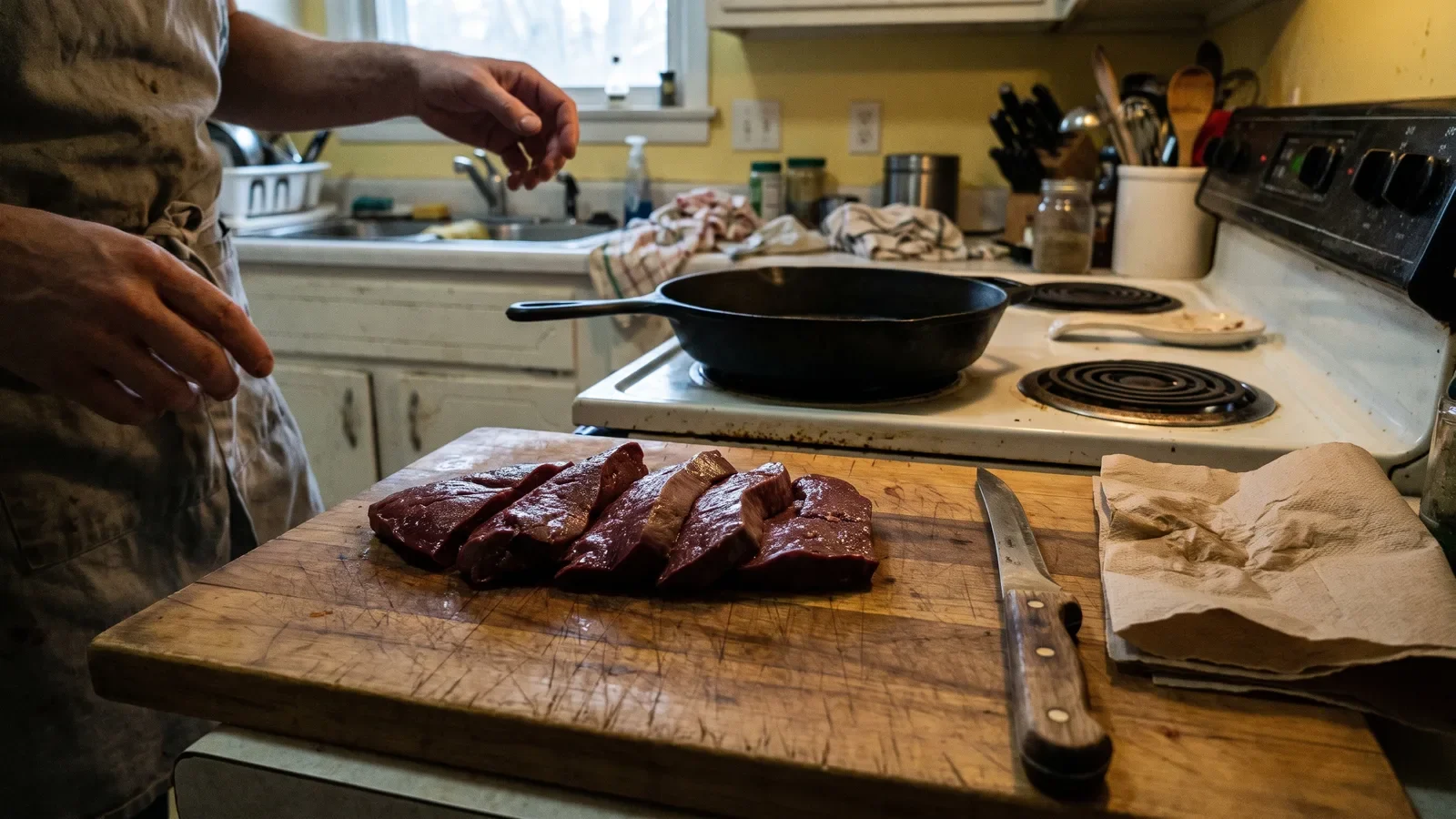
Two different complaints hide behind one word. The first is flavor: a metallic, bitter, almost barnyard edge that coats your tongue and stays there. The second is texture: dry, chalky slices that fight back against a fork.
Flavor trouble comes from what is still inside the tissue when it hits the pan — blood, and the aroma compounds that collect in a hard-working organ. Pulling those out before cooking is the whole game. A 2023 study in the journal Foods found that soaking beef liver in a 1% salt solution for 60 minutes significantly reduced its off-odor, at p < 0.05.
Texture trouble is a clock problem. Liver carries almost no collagen, so there is no low-and-slow reward waiting on the far side of overcooking; the proteins simply tighten, water leaves, and the slice goes grainy.
The membrane is the quiet third culprit. That thin silver skin shrinks faster than the meat around it and curls each slice into a dome, so the middle steams while the rim scorches. Peel it off and the slice lies flat against hot metal.
Fix the order of operations and most of the misery disappears: fresh liver, trimmed, soaked cold, dried hard, seared fast, checked with a thermometer.
What You Need: Liver, Soaking Liquid and Equipment Checklist
Shop first, then set up. Calf’s liver, from younger animals, is paler, milder and more tender than liver from mature cattle, which runs darker and stronger in flavor. Both respond to the same treatment, but if bitterness is your main worry, ask the butcher for calf’s liver and have it sliced for you.
Here is the full kit for about a pound of liver, enough for four servings:
- Beef or calf’s liver, in slices of even thickness rather than one thick lobe
- Plain non-iodized salt and a kitchen scale, so you can mix the soak by weight
- Cold tap water, plus room in the refrigerator for the soaking dish
- A wide, shallow dish or container that holds the slices in a single layer
- A sharp boning or utility knife and a stack of paper towels for grip and drying
- A heavy 10- to 12-inch skillet, cast iron or carbon steel, which holds heat when cold meat lands
- An instant-read thermometer — guessing is how liver gets overcooked
- High-smoke-point fat such as ghee, beef tallow or a neutral oil, with butter reserved for the end
- Flour or rice flour for an optional dredge, and tongs plus a warm plate for resting
Skip the nonstick pan if you own anything heavier. Thin pans drop in temperature the moment the liver touches them, and that temperature crash is what turns a sear into a slow gray simmer.
Step 1 — Buy Fresh Liver and Treat It as Highly Perishable
*Time: your shopping trip, plus two minutes of unpacking. Bring an insulated bag.*
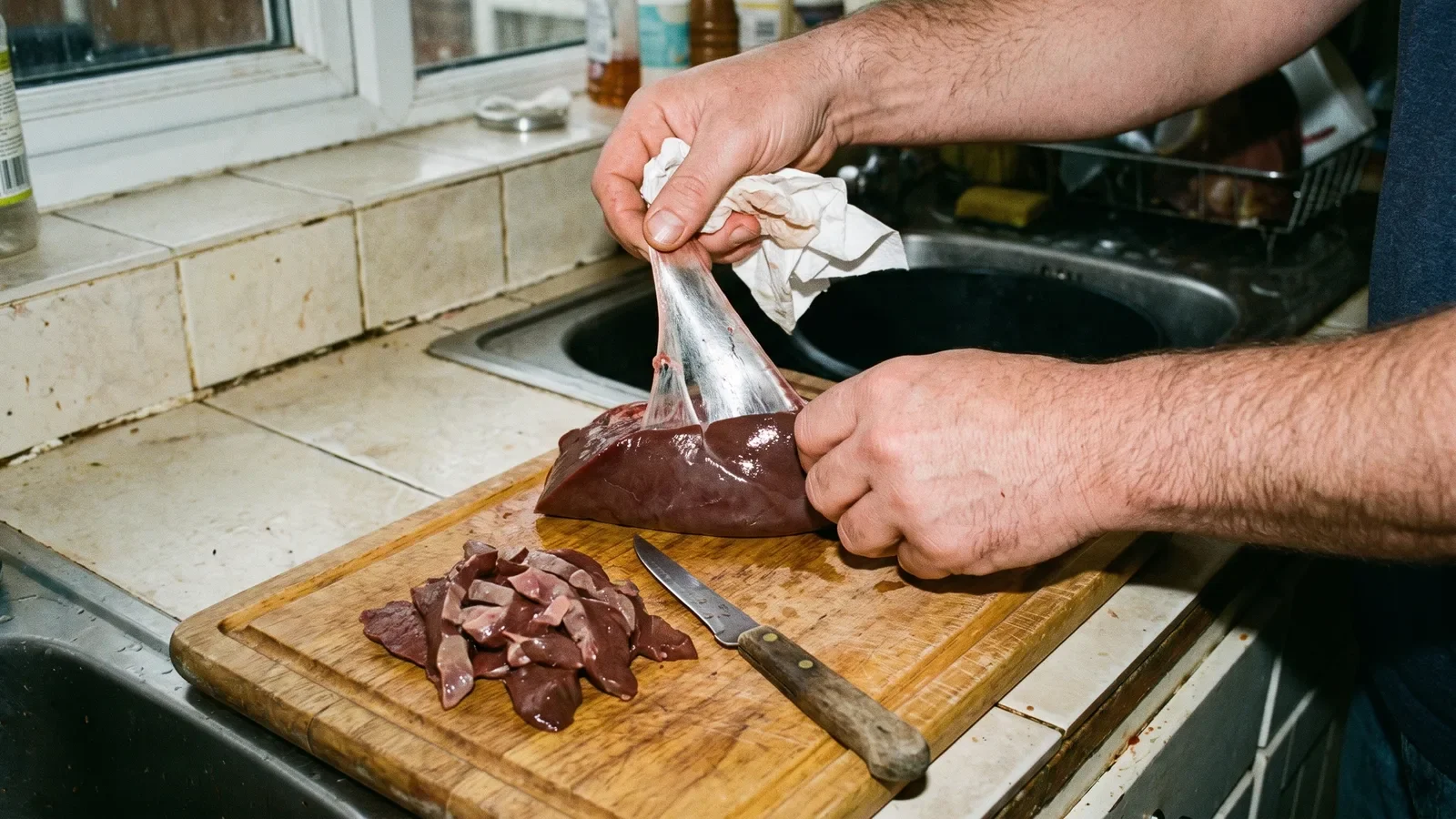
Liver spoils faster than steak, and spoilage reads on the plate as bitterness. USDA’s Food Safety and Inspection Service gives fresh beef liver and other variety meats only 1 or 2 days in the refrigerator, versus 3 to 4 months in the freezer. Plan your cooking date before you buy, not after.
Look for a glossy, deep reddish-brown surface with no gray or green cast, and no pooled liquid sitting in the tray. The smell at the counter should be clean and faintly mineral. Dull, tacky, strong-smelling liver will not improve in a soak.
USDA’s Food Safety and Inspection Service advises refrigerating beef at 40 degrees F and using variety meats such as liver within 1 or 2 days, compared with 3 to 5 days for other beef cuts. Put it in the coldest part of your refrigerator, usually the back of the bottom shelf, the minute you get home.
USDA food safety basics say fresh variety meats should be cooked or frozen within 2 days, while other beef, veal, lamb or pork can wait 3 to 5 days. If dinner slips to the weekend, freeze the slices flat in a single layer and thaw them in the refrigerator.
Step 2 — Trim the Membrane and Slice to an Even Thickness
*Time: about 10 minutes. You need a sharp knife, a board and paper towels.*
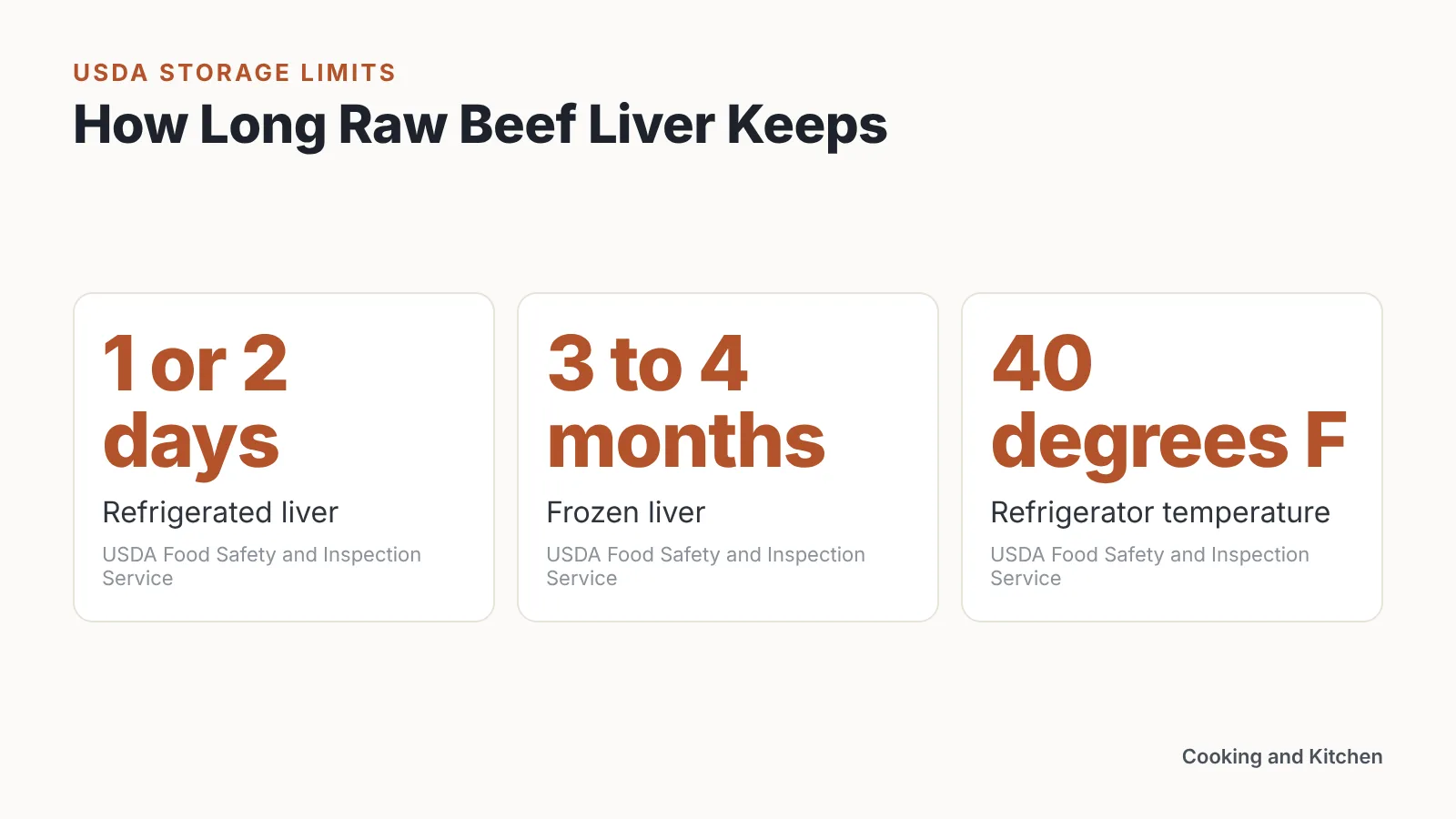
Work with cold liver straight from the refrigerator; it firms up the surface and makes the membrane easier to find. Lift a corner of the thin outer skin with your knife tip, grip the flap with a paper towel so it does not slide, and pull it back across the lobe in one steady motion. It usually comes away in a sheet or two.
Slice to a consistent thickness, which matters far more than the exact number. Half an inch is a good target: thick enough to stay juicy during a hard sear, thin enough to reach a safe temperature before the crust burns. Uneven slices guarantee that one piece is raw while another is leather.
Cut out the larger white tubes and any tough connective webbing as you go. A quick pass over each slice with the knife flat, shaving off stray silverskin, pays off in the pan. Lay the trimmed slices in a single layer in your soaking dish rather than stacking them.
Step 3 — Soak Cold to Pull Out the Bitter, Metallic Notes
*Time: 60 minutes, almost all of it hands-off. You need salt, cold water and refrigerator space.*
This is the step that decides whether your liver tastes mineral-sweet or aggressively metallic. In the 2023 Foods study, the 60-minute soak in 1% salt scored the lowest off-odor rating, about 1 on the researchers’ scale, the best result of all the soaking treatments tested. Mix 10 grams of salt into 1 liter of cold water on a scale and you have that concentration.
Soaking beef liver in plain water only lowered its off-odor score from 5 to about 3 in the same experiment, far less than the salt solution achieved. Salt water is the stronger tool, and it costs nothing extra.
Keep the dish cold the entire time. The researchers in that study carried out all liver soaking at a refrigerated 4 degrees C, testing durations of 30, 60 and 90 minutes in 1.0% salt solution or distilled water.
| Soaking liquid | What the Foods (2023) study tested | Reported result |
|---|---|---|
| 1.0% salt solution | 30, 60 and 90 minutes at 4 °C | 60 minutes scored the lowest off-odor, about 1 on the researchers’ scale |
| Distilled water | 30, 60 and 90 minutes at 4 °C | Off-odor fell from 5 to roughly 3 |
| Milk | Not part of that study | No finding to quote either way |
Milk soaking is traditional and plenty of cooks swear by it, but that study did not test it, so treat it as kitchen lore rather than a measured result.
Step 4 — Dry, Season and Dredge Just Before Cooking
*Time: 5 minutes. You need paper towels, salt, black pepper and optional flour.*
Drain the soak and blot every slice on both sides until the paper towel comes away barely damp. Surface water is the enemy of browning: it has to boil off before the pan can start building crust, and during that delay the inside keeps cooking. Dry liver browns in a minute; wet liver sulks and turns gray.
Season right before the slices go in the pan, not ten minutes earlier. Salt drawn out onto the surface creates exactly the wet layer you just worked to remove. Black pepper, a little salt, and that is enough — the soak already softened the flavor you were fighting.
Dredge if you want a crisper edge and a sauce that thickens itself. Dip each slice in flour or rice flour, then shake it hard so only a thin film remains; clumps burn before the liver is done. Heat your fat while you dredge so the pan is ready the moment the last slice is coated.
Step 5 — Sear Fast and Pull at the Safe Temperature
*Time: about 10 minutes for two batches. You need a heavy skillet, fat, tongs and an instant-read thermometer.*
Get the skillet over medium-high heat until a drop of water skitters, add enough ghee or tallow to coat the surface, and wait for it to shimmer. Lay the slices down away from you with space between them, and leave them alone. Crowding drops the pan temperature and steams the liver in its own juices.
Expect roughly two minutes on the first side for half-inch slices, then a flip and a shorter stretch on the second. Browning should be deep and patchy, not uniform beige.
USDA’s Food Safety and Inspection Service tells home cooks to cook all organ and variety meats, including liver, to an internal temperature of 160 degrees F (71.1 degrees C). Slide the thermometer in from the side of a slice, through the thickest point, and pull the pan off the heat as soon as it reads there. Rest the slices on a warm plate for two or three minutes while you swirl butter, onions or a splash of vinegar into the pan drippings.
Common Mistakes That Make Liver Bitter, Grainy or Tough
The single most common failure is cooking the slices straight out of the soak while they are still wet, piled into one crowded pan. The liquid that leaches out pools, reduces, and bastes the meat in concentrated bitterness while the surface never browns. Dry each slice thoroughly and cook in two uncrowded batches, wiping the pan between them if the drippings scorch.
Other repeat offenders:
- Leaving the membrane on. It curls the slice, blocks contact with the pan and turns chewy.
- Skipping the salt and soaking in plain water. The Foods study showed water alone cut off-odor only from 5 to about 3.
- Soaking on the counter. The study’s soaks were done at a refrigerated 4 degrees C; a warm bowl of salty liver is a food safety problem, not a flavor fix.
- Cooking by eye. Liver goes from juicy to chalky in under a minute, which is why the thermometer is not optional.
- Holding raw liver too long. USDA’s Food Safety and Inspection Service allows fresh variety meats only 1 or 2 days in the refrigerator.
- Slicing unevenly. Mixed thicknesses mean half the batch is overdone before the other half is safe.
Quick Checklist Before You Start
- [ ] Liver bought for cooking within 1 or 2 days, kept at 40 degrees F
- [ ] Membrane peeled, tubes trimmed, slices cut to one even thickness
- [ ] 10 grams of salt per liter of cold water, slices in a single layer
- [ ] Dish in the refrigerator for 60 minutes, not on the counter
- [ ] Slices blotted dry, seasoned at the last second
- [ ] Heavy skillet preheated, fat shimmering, two batches planned
- [ ] Instant-read thermometer in hand, target 160 degrees F
Frequently asked questions
Should you soak beef liver in milk or salt water?
Salt water has the measured result behind it. A 2023 study in the journal Foods found that soaking beef liver in a 1% salt solution for 60 minutes significantly reduced its off-odor, while milk was not among the treatments tested in that work, so it remains traditional advice rather than a tested one.
What internal temperature should beef liver reach?
USDA’s Food Safety and Inspection Service tells home cooks to cook all organ and variety meats, including liver, to an internal temperature of 160 degrees F (71.1 degrees C). Check the thickest slice by inserting the probe horizontally through the side, then pull the pan off the heat immediately.
How long can raw beef liver sit in the refrigerator?
USDA’s Food Safety and Inspection Service gives fresh beef liver and other variety meats only 1 or 2 days in the refrigerator, compared with 3 to 5 days for other beef cuts. Freezing extends that to 3 to 4 months, so freeze flat slices if your plans change.
Why is my liver still bitter after soaking it?
Three usual reasons: the membrane stayed on, the soak was plain water, or the dish sat out warm. Soaking beef liver in plain water only lowered its off-odor score from 5 to about 3 in the Foods study, and all of that study’s soaking was done at a refrigerated 4 degrees C.
Does a longer soak work better than 60 minutes?
Not according to the evidence. The researchers in the 2023 Foods study tested 30, 60 and 90 minutes in 1.0% salt solution, and the 60-minute soak scored the lowest off-odor rating, about 1 on their scale, so extending the soak gained nothing measurable.
Sources
AI tools helped write this guide. The Cooking and Kitchen Editorial Team published it after checking every figure against the sources linked above.
Related articles

Cooking and Kitchen Editorial Team
Articles on Cooking and Kitchen are written by the editorial team with AI assistance and checked against the cited sources.


You May Also Like
How to Cook Bone Marrow at Home, Roasted and Served
How to Cook Oatmeal That Turns Out Creamy Every Time