How to Cook Corned Beef Brisket Until Fork-Tender
Here’s how to cook corned beef brisket: cover it with water and cook it gently — a bare stovetop simmer, a covered oven, or a slow cooker — until a thermometer clears the USDA FSIS minimum and a fork slides in.
Quick steps: corned beef brisket on the stove, in the oven or a slow cooker
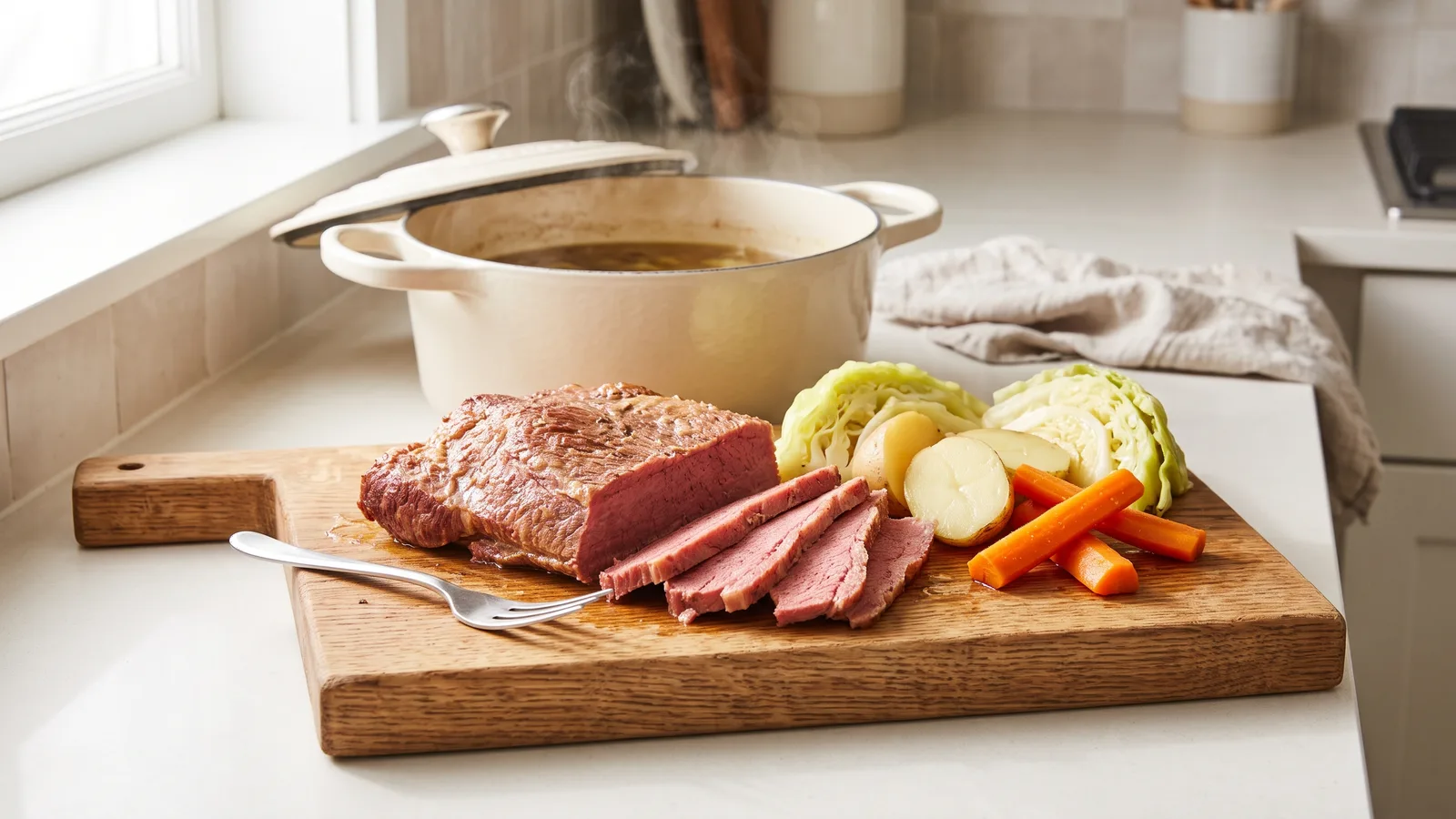
Corned beef brisket is a brined, hard-working cut, and it only turns sliceable after hours of gentle moist heat. Choose the appliance that fits your day. The five moves are the same whichever you pick.
- Rinse the brisket under cold water, pat it dry, and set the spice packet aside.
- Put it fat-side up in a heavy pot, deep roasting pan or slow cooker and add water.
- Cook it covered and gentle — a bare simmer, a moderate oven, or a slow cooker — never a rolling boil.
- Add potatoes, carrots and cabbage late so they finish whole instead of collapsing.
- Check the internal temperature, rest the meat, then slice across the grain.
USDA FSIS does not rank stove, oven, microwave or slow cooker as the single best way to cook corned beef, and it treats "fork-tender" as an indicator of doneness that should still be confirmed with a thermometer. That takes pressure off the choice. Decide based on what you want to be doing for the rest of the afternoon, and on whether you need the oven free for anything else.
What to decide first: cut, method and timing
Two decisions matter before anything hits the water: which cut is in the package, and how much of the day you want to spend near the stove.
Flat cut (sometimes labeled first cut) is lean and rectangular, and it slices into tidy planks — buy it for sandwiches and a neat platter. Point cut (the deckle end) carries more fat, shreds easily, and forgives a long cook. Both are brisket, and both need the same low, wet heat.
| Method | Setting | Timing | Water | Suits you if |
|---|---|---|---|---|
| Stovetop | Bring to a boil, then reduce to a simmer (USDA FSIS) | About 1 hour per pound (USDA FSIS) | Enough to keep the meat covered | You’re home and can skim and top up |
| Oven | 350°F (USDA FSIS) | Cook until fork-tender, then verify with a thermometer | About 1 inch, barely covering, fat-side up (USDA FSIS) | You want the stovetop free |
| Slow cooker | High for the first hour, then low or high (USDA FSIS) | 10 to 12 hours on low, or 5 to 6 hours on high (USDA FSIS) | Enough to surround the meat | You want to start it and walk away |
USDA FSIS notes that slow cookers operate at roughly 170°F to 280°F, a low, moist heat that suits tough cuts like brisket. Pot size is the other hard limit. The brisket must lie reasonably flat and stay under liquid; if your Dutch oven is too small, cut the slab in half crosswise rather than folding it. Lining up the pot, vegetables and thermometer before you start — the habit behind mise en place — keeps the late stages calm.
Step 1 — Prep the brisket: rinse, trim, spice packet and the right pot
What you need: a heavy pot or Dutch oven deep enough to submerge the meat, or a deep roasting pan, or a slow cooker whose lid closes over the brisket. Add tongs, an instant-read thermometer, and a cutting board with a juice groove.
Rinse the brisket under cold running water and rub the surface lightly with your fingers. This washes off clinging cure and loose spice, which takes the sharp edge off the saltiness. It will not make the meat low-sodium — the brine is already inside the muscle.
Look at the fat cap. If it is thick and hard, trim it back to a thin, even layer; leave enough to melt over the meat during the cook. Trimming it off completely costs you flavor and makes the lean flat cut drier.
The spice packet is usually coriander seed, mustard seed, black peppercorns, bay leaf and sometimes dill seed. Scatter it over the meat or drop it into the water. If your brisket came without one, build your own from those whole spices and add a couple of smashed garlic cloves.
Step 2 — Cook it low and slow: stovetop simmer, 325–350°F oven, or slow cooker
All three routes do the same job: hold the meat in hot liquid long enough for tough collagen to melt into gelatin. What changes is how much attention each one asks for.
Stovetop
USDA FSIS says to bring the water to a boil, then reduce to a simmer and allow about 1 hour per pound. Keep the surface barely moving — small bubbles at the edge, no churn. Skim the gray foam in the first half hour and top up with hot water if the meat pokes above the liquid.
Oven
For oven cooking, USDA FSIS specifies 350°F (and no lower than 325°F), with the brisket fat-side up and barely covered with about 1 inch of water. Cover the pan tightly with a lid or a double layer of foil so steam stays in. Check once partway through and add hot water if the pan looks dry.
Slow cooker
In a slow cooker, USDA FSIS directs cooking on high for the first hour, then 10 to 12 hours on low or 5 to 6 hours on high. Resist lifting the lid; every peek drops the temperature and stretches the cook. The high route — that first hour plus 5 to 6 hours more — is the one you can start after breakfast and serve at dinner; the low route runs 11 to 13 hours end to end, so it has to go in the night before or at first light.
Step 3 — Add cabbage, potatoes and carrots on schedule
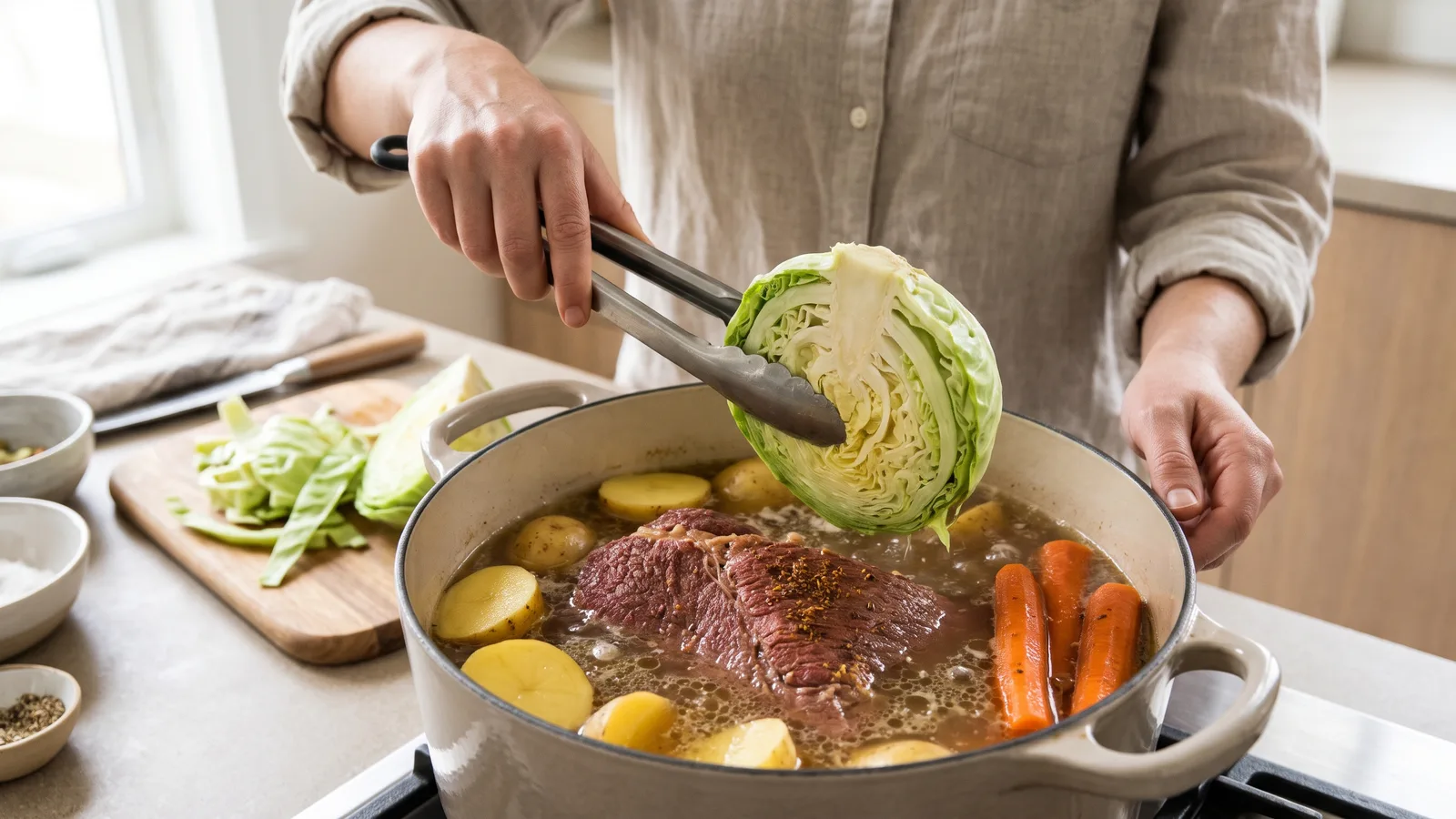
Vegetables need a fraction of the brisket’s time, so they go in near the end. USDA FSIS says cabbage wedges go on top of the brisket during the last 3 hours of slow-cooker cooking, in about 1 1/2 cups of water.
On the stove or in the oven, work by signs rather than the clock. Add halved small potatoes and thick carrot batons once the brisket gives easily when you twist a fork in it, then lay the cabbage wedges on top when a paring knife slides into a potato with slight resistance.
Cut cabbage into wedges through the core so each piece holds together instead of falling into shreds. Keep carrots in chunks at least as thick as your thumb; thin coins disintegrate in salty broth.
Taste the cooking liquid before you commit the vegetables to it. If it is punishingly salty, ladle out a few cups and replace them with plain hot water — the brisket is already seasoned through and will not suffer.
Step 4 — Rest, slice against the grain and store the leftovers
Lift the brisket onto a board and tent it loosely with foil while the vegetables finish. Resting lets the juices settle so they stay in the slices instead of flooding the board. Ten minutes is enough for a lean flat cut; a fatty point can sit longer.
Find the grain before the knife touches the meat. On a flat cut the fibers usually run the length of the slab, so you slice crosswise, pencil-thin. The same rule that keeps a flat iron steak tender when you slice it applies here, only the fibers are longer and tougher.
Point cut is trickier because two muscles meet at an angle. Separate them along the fat seam, then slice each one across its own grain.
USDA FSIS says to use cooked-ahead or leftover corned beef within 3 to 4 days refrigerated, or freeze it for 2 to 3 months. Store it whole or in thick slabs with a little cooking liquid, which keeps the lean side from drying out, and slice to order. Cold corned beef is some of the best sandwich and hash material you can build a week of weekday meals around.
Is it done? Temperature, the fork test, and why it’s still pink
USDA FSIS says all raw corned beef must be cooked to a minimum internal temperature of 145°F, measured with a food thermometer, before it comes off the heat. That is the safety floor, not the tenderness target.
Probe the thickest part of the flat, away from the fat cap and away from the bottom of the pot. If the reading clears the minimum but the meat still fights the fork, keep cooking — collagen needs time at temperature, and a brisket pulled early slices into tough, stringy strips.
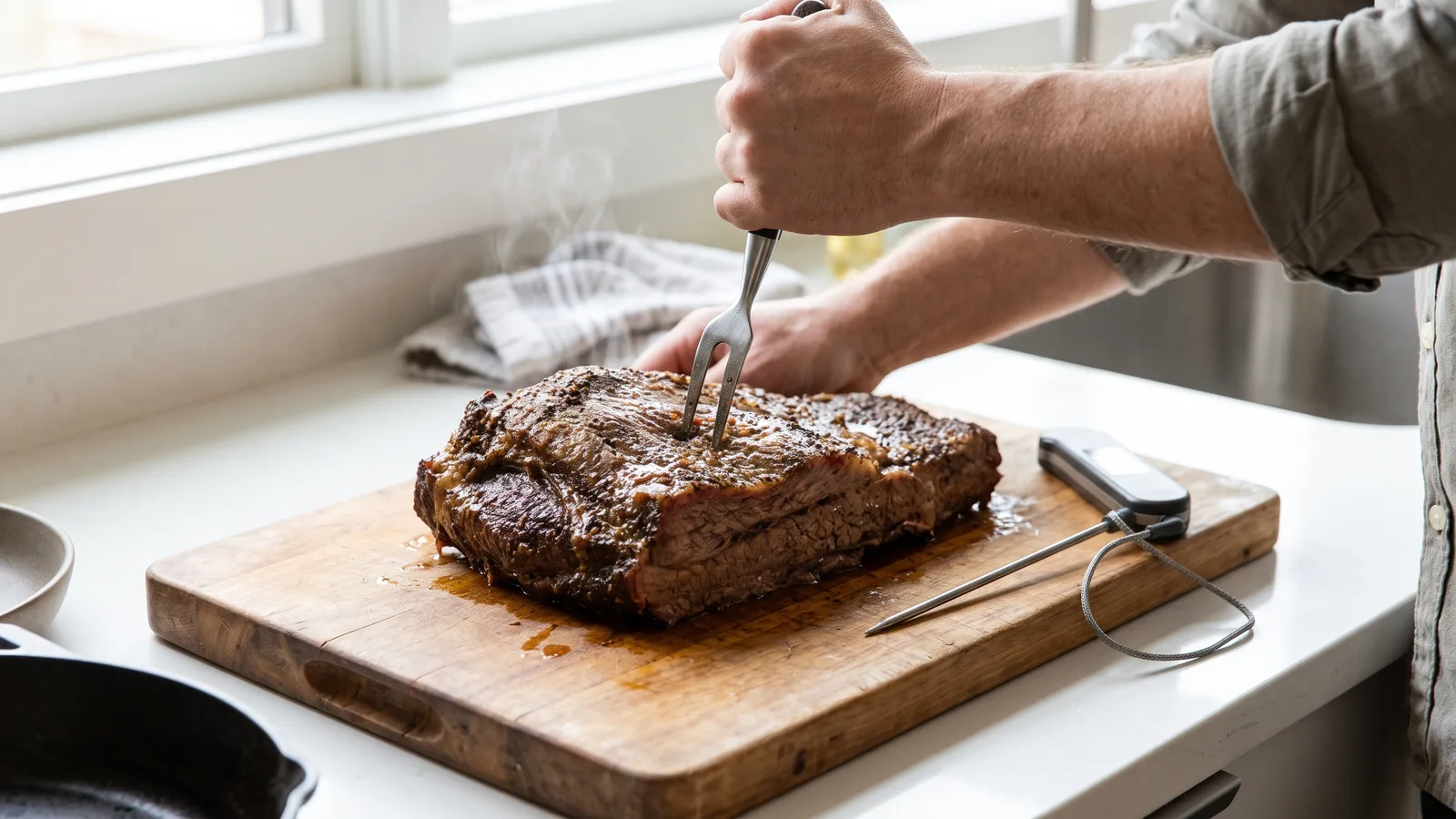
The fork test is simple: push a carving fork into the thickest section and twist. Done brisket lets the tines turn with almost no resistance and the meat starts to pull apart at the surface.
Pink meat is not a sign of undercooking here. Curing salts react with the muscle pigment and lock in that rosy color, so a fully cooked corned beef brisket still looks pink all the way through. Judge by the thermometer and the fork, never by color.
Before you serve: a quick checklist and the mistake to avoid
Run through this before the platter goes to the table:
- ☐ Brisket rinsed, fat cap trimmed to a thin layer, spices added
- ☐ Meat fat-side up and covered by liquid for the whole cook
- ☐ Liquid at a bare simmer, with no hard rolling boil at any point
- ☐ Thermometer reading taken in the thickest part, not near fat or the pot bottom
- ☐ Fork twists freely in the meat before you take it out
- ☐ Brisket rested and sliced across the grain
- ☐ Leftovers cooled and refrigerated or frozen within the USDA window
The failure that ruins most home corned beef is heat, not time. A pot left at a full boil squeezes the muscle fibers shut, drives out moisture and leaves you with dry, shreddy meat swimming in broth. Watch the pot after it comes up to temperature and drop the burner until only a few bubbles break the surface; if your stove’s lowest setting still boils, move the covered pot into a 350°F oven instead — USDA FSIS says no lower than 325°F.
Frequently asked questions
Which method is best — stovetop, oven or slow cooker?
USDA FSIS does not name one as better; stove, oven, microwave and slow cooker are all listed as ways to cook corned beef. Choose by schedule: the stove needs supervision, the oven frees your burners, and the slow cooker runs unattended all day.
Do I really need to rinse corned beef before cooking it?
Rinsing under cold water removes surface cure and loose spice, which softens the salty edge of the finished meat and the cooking broth. It will not desalt the inside, since the brine already penetrated the muscle during curing.
Why is my corned beef still pink after hours of cooking?
Curing salts react with the meat’s pigment and fix that pink color permanently, so fully cooked corned beef stays rosy. Judge doneness by a thermometer reading in the thickest part plus a fork that twists without resistance, never by color.
Should I buy flat cut or point cut brisket?
Flat cut is lean and rectangular and gives you neat, even slices for sandwiches and platters. Point cut carries more fat, shreds easily, tastes richer and forgives a longer cook, so it suits hash, tacos and pull-apart servings.
How long will cooked corned beef keep?
USDA FSIS says to use cooked-ahead or leftover corned beef within 3 to 4 days refrigerated, or freeze it for 2 to 3 months. Store it in thick pieces with a splash of cooking liquid and slice as you need it.
Sources
AI tools helped write this guide. The Cooking and Kitchen Editorial Team published it after checking every figure against the sources linked above.
Related articles

Cooking and Kitchen Editorial Team
Articles on Cooking and Kitchen are written by the editorial team with AI assistance and checked against the cited sources.


You May Also Like
How to Make Oak Kitchen Cabinets Look Modern
How to Cook Bone Marrow at Home, Roasted and Served