How to Cook Flat Iron Steak So It Stays Tender
How to cook flat iron steak that stays tender: dry-brine it, sear it hot and fast over high heat, pull it at 140°F for medium rare (a beef checkoff pull temp; USDA’s minimum is 145°F — see the temperature section), rest 5 minutes, then slice thin across the grain.
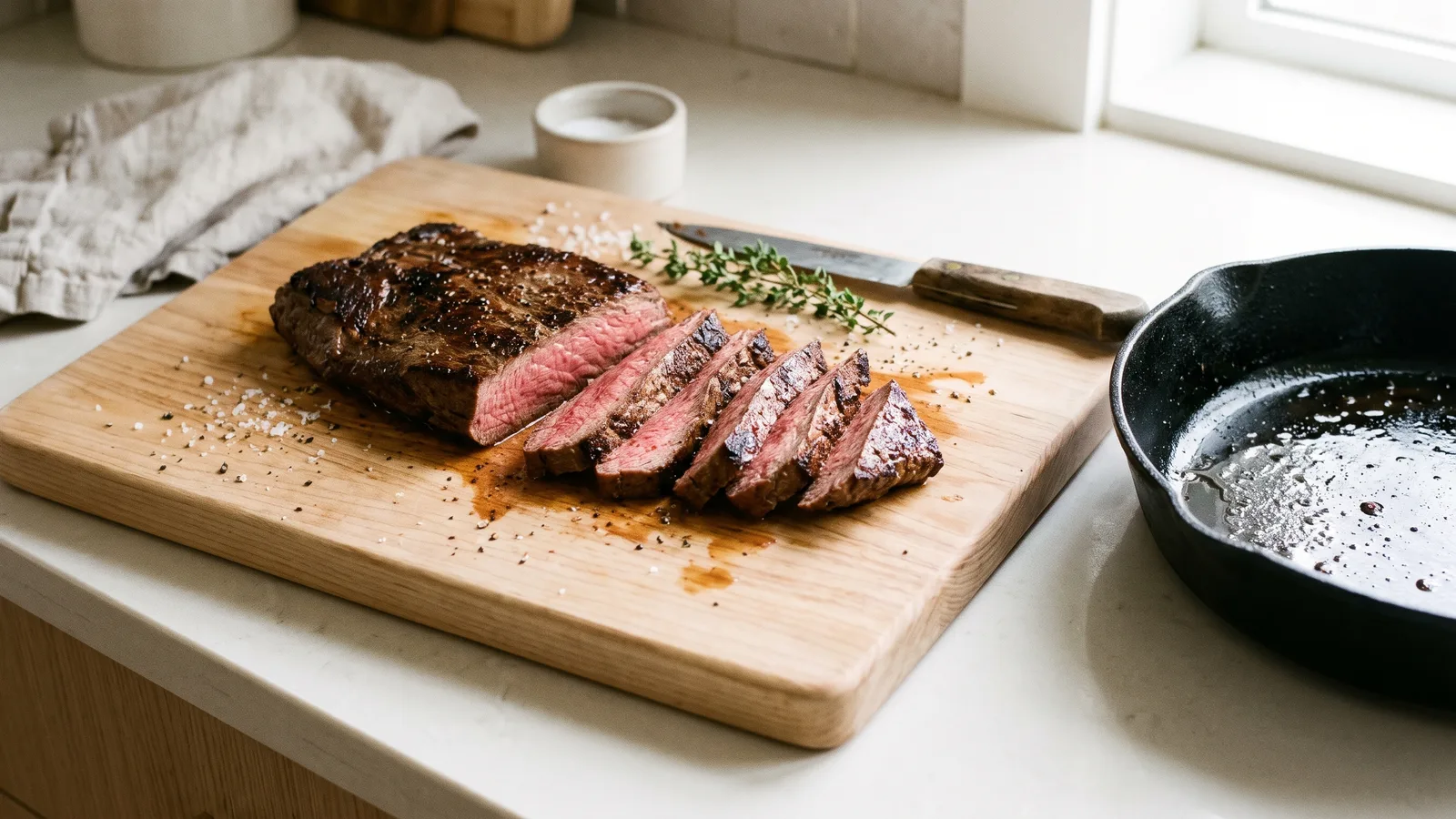
Quick steps for tender flat iron steak
Flat iron comes from the shoulder — specifically the infraspinatus, the muscle that sits under the shoulder blade. Beef checkoff muscle-ranking research found the psoas major (tenderloin) and the infraspinatus — the flat iron muscle — to be the two most tender beef muscles, with sensory tenderness ratings correlating to shear-force means at -0.85 (P=0.001). The tenderness is already in the meat, so your job is to avoid wrecking it.
- Trim the silverskin, and on a thick whole flat iron, split it along the tough center seam.
- Salt both sides and leave the steak uncovered on a rack in the fridge.
- Heat cast iron, or one zone of the grill, until the oil shimmers and smokes faintly.
- Sear hard, flip once, and track the center with an instant-read thermometer rather than a clock.
- Rest the steak, then slice it thin at a right angle to the fibers.
Everything below is the detail behind those five moves, grouped into four steps. Two of the moves decide the result: where you stop the cooking, and which direction your knife travels. Get those right and a shoulder cut that costs a fraction of tenderloin eats like a steakhouse cut.
What to decide first: thickness, doneness and method
Three choices set the plan before any heat is involved. How thick is the steak, where do you want the center to land, and what are you cooking on? A whole flat iron from a butcher is often a thick double steak with a band of connective tissue running down the middle, while a supermarket flat iron has usually had that seam removed already.
| Decision | Your options | What it changes |
|---|---|---|
| Thickness | Thin, even steak / thick whole steak | Thin takes a straight sear; thick is better split or reverse-seared |
| Doneness | Medium rare / medium | Beef checkoff pull temperatures of 140°F or 155°F |
| Method | Cast-iron skillet / charcoal / gas / reverse sear | Charcoal and gas have published time ranges; skillet runs on crust cues |
| Center seam | Leave whole / split into two steaks | Splitting removes the chewy strip but gives you two thinner steaks |
The beef checkoff’s official grilling chart gives an 8-ounce flat iron steak a total grilling time of 10 to 14 minutes over charcoal and 12 to 16 minutes on gas, for medium rare to medium. Treat those as a window, not an alarm — thickness and starting temperature move them.
Pull your tools and seasonings out before the burner goes on. If you tend to scramble mid-cook, a practical guide to setting up your station before you start is worth five minutes of reading.
Step 1 — Prep the steak: trim the center seam, then dry-brine
What you need: a sharp boning or paring knife, paper towels, kosher salt, a wire rack set over a sheet pan.
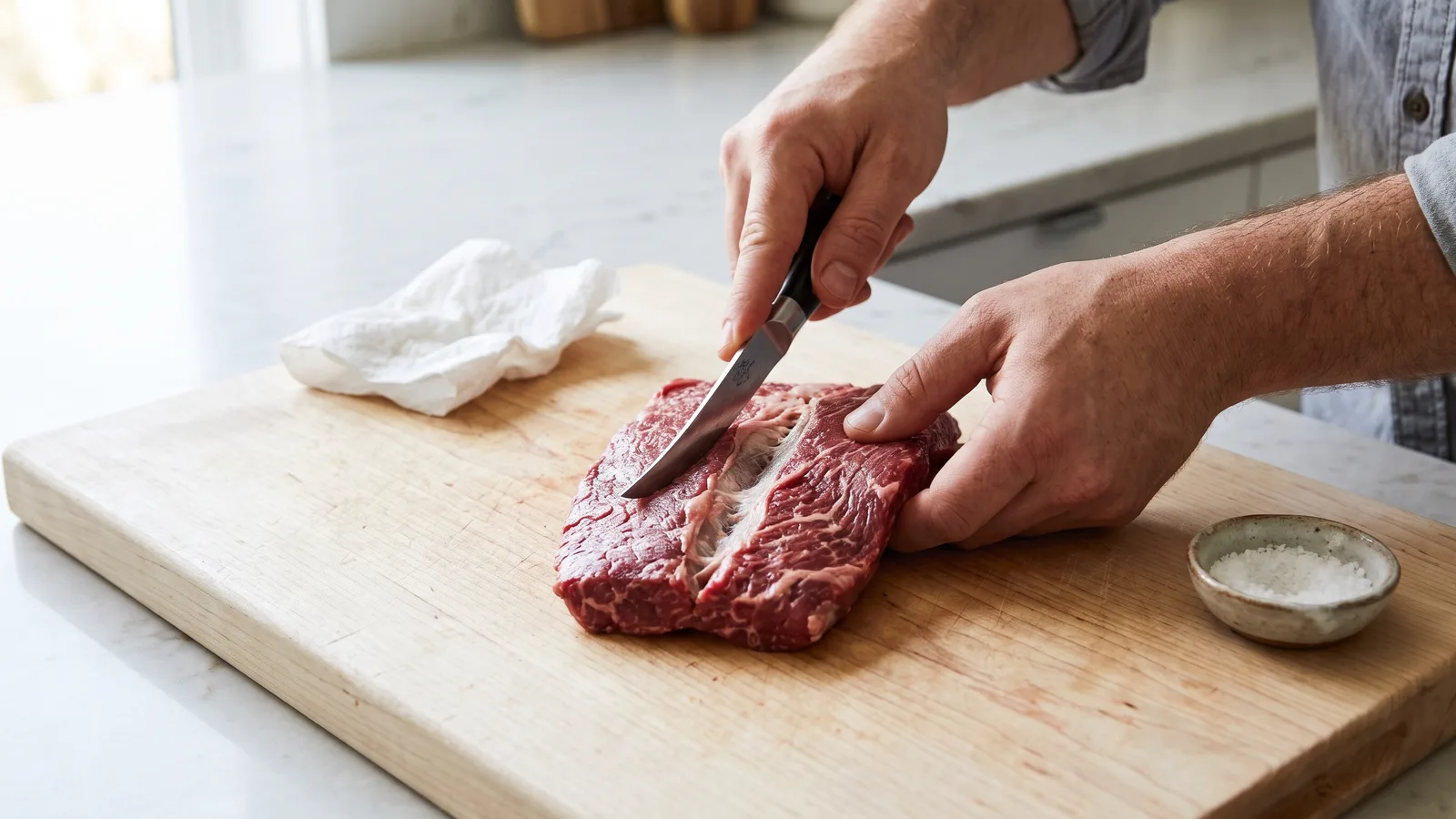
Pat the steak completely dry, then look at it edge-on. A whole flat iron shows a pale line of connective tissue through the middle; slide your knife along it and separate the steak into two flat pieces, scraping off the silverskin as you go. That membrane never softens at steak temperatures, and it is the single most common reason people call this cut chewy.
Salt both sides generously, then leave the steak uncovered on the rack in the fridge. The salt dissolves, pulls moisture in, and dries the surface so it browns instead of steaming. An hour helps; overnight is better if you planned ahead.
Skip the sugar-heavy rubs for a first attempt. Salt, coarse black pepper and a thin film of neutral oil are enough to judge what the cut actually tastes like.
Step 2 — Preheat properly: skillet, grill or reverse-sear setup
What you need: cast iron or carbon steel, a high-smoke-point oil such as grapeseed or refined avocado, long tongs, an instant-read thermometer.
A skillet is ready when a bead of oil shimmers and sends up the first wisp of smoke. On charcoal, bank the coals to one side so you have a searing zone and a cooler zone; on gas, run one burner wide open and leave another off. You want a hot surface and an escape route, because a thin flat iron goes from rare to gray fast.
For a thick split steak, the reverse sear is the forgiving option. Warm the steak slowly in a low oven, stop the oven stage short of your pull temperature, then finish it in a ripping-hot skillet — the sear adds heat quickly, so the oven stage must end early.
Tongs and a fast thermometer matter more than the pan brand here. If your drawer is short on either, a buyer’s guide to building a usable utensil set covers what earns its space.
Step 3 — Sear, flip once and pull before your target
What you need: the preheated pan or grill, tongs, thermometer, a resting plate or board standing by.
Lay the steak down away from you and leave it alone. Moving it early tears the crust that is still forming, and every lift drops the surface temperature. When the underside releases cleanly and looks deeply browned, flip it once.
The beef checkoff’s Beef. It’s What’s For Dinner grilling guidelines tell cooks to pull steaks off the grill at 140°F for medium rare or 155°F for medium, then let them stand 5 minutes. Probe the thickest part from the side, not the top, so the tip sits in the center rather than poking through to the hot pan.
Flare-ups on a grill are a cue, not a crisis — slide the steak to the cool zone until the flames die down. Butter, garlic and thyme can go in during the last stretch in a skillet, spooned over the top. Keep the butter late; it burns at searing heat.
Step 4 — Rest, then slice thin against the grain
What you need: a cutting board with a juice groove, a sharp slicing knife, foil only if your kitchen is cold.
USDA’s Food Safety and Inspection Service advises letting cooked beef rest at least three minutes before carving or eating, for both safety and quality. Five minutes suits a flat iron: long enough for the center to settle, short enough that the crust stays crisp. Tent loosely or not at all, because tight foil steams the surface you just worked to build.
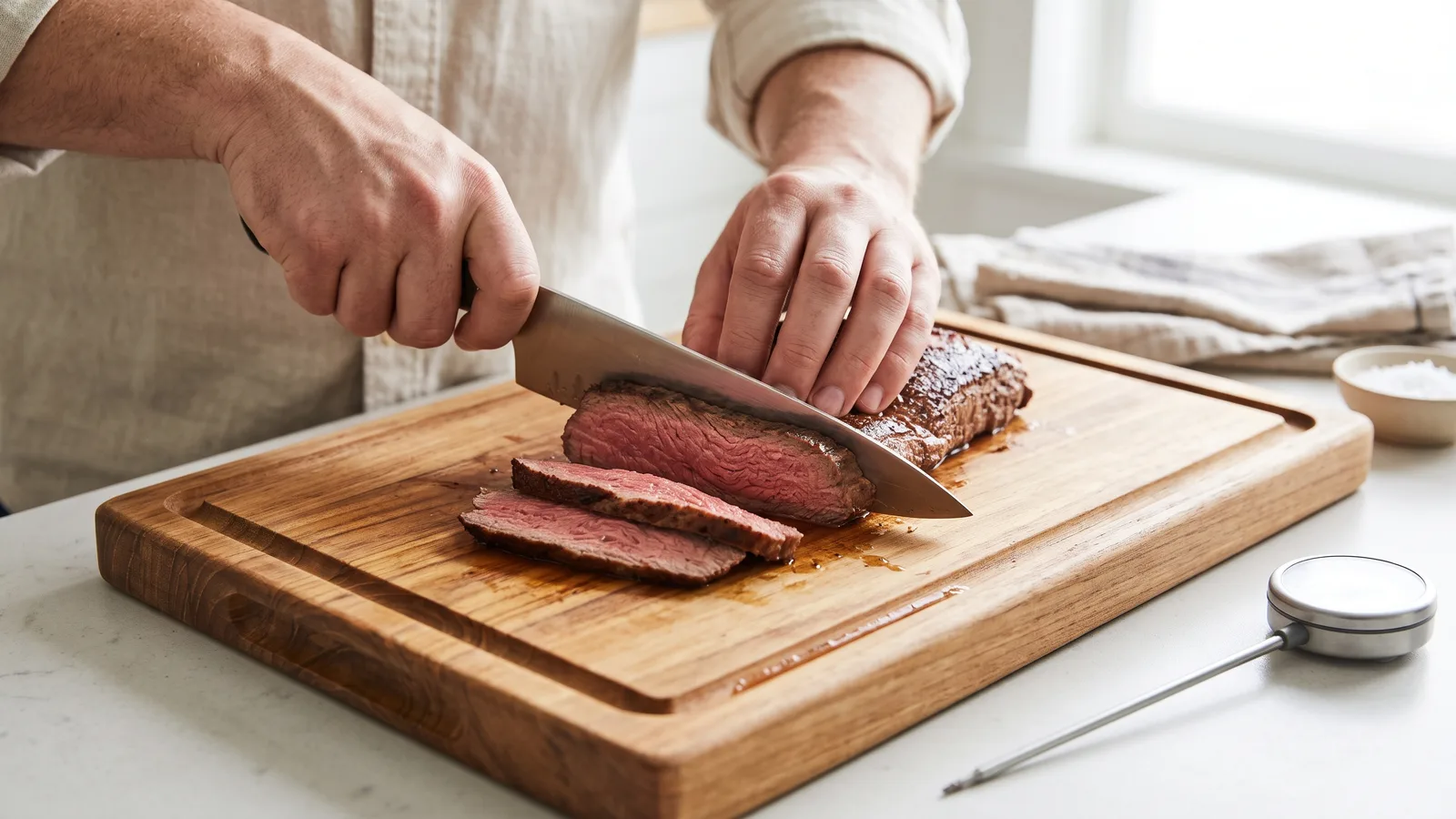
Find the grain before you cut. On a flat iron the fibers run clearly in one direction along the length of the steak, and your knife must cross them at a right angle. Slice thin, hold the knife at a slight angle for wider pieces, and fan the slices out on a warm plate.
Cutting with the grain leaves long fiber bundles intact, and even a perfectly cooked steak will feel stringy. Turn the board, not the knife, if that helps you keep the angle honest.
How to check you got it right: temperature, carryover and texture
The thermometer is the referee. USDA’s Food Safety and Inspection Service says all raw beef steaks and roasts should be cooked to a minimum internal temperature of 145°F (62.8°C), measured with a food thermometer; the checkoff chart pairs 140°F with a 5-minute stand, while USDA states 145°F as the minimum measured temperature. Decide which standard you are cooking to before the steak hits the heat, and tell anyone you are feeding.
Carryover is real: a steak keeps climbing after it leaves the pan, more so on a thick piece than a thin one. That is why pulling at your target instead of before it reliably produces one grade past what you wanted.
Run this checklist before you serve:
- Silverskin and the center seam removed, not cooked in.
- Surface dry at the moment it hit the pan; no gray steamed patches.
- Deep brown crust on both faces after a single flip.
- Center probed from the side, at your chosen temperature.
- Rested, then sliced thin at a right angle to the fibers.
- Slices bend without resistance and give up a little juice, not a puddle.
The common failure: slicing the steak lengthwise, with the grain, because that is the direction the board is already facing. Avoid it by marking the grain direction with your eyes before cooking, then turning the board 90 degrees the moment the steak comes off the heat. Leftovers stay tender if you slice them cold and add them to grain bowls or salads rather than reheating them hard — a weekday plan that keeps cooked proteins eating well for days is a sensible companion read.
Frequently asked questions
Do you need to marinate flat iron steak?
No. The beef checkoff’s published muscle-tenderness ranking classifies the infraspinatus in the "tender" category, defined as a Warner-Bratzler shear force below 3.9 kg, so an acid marinade adds flavor at best and mushy surface texture at worst. Salt, pepper and heat are enough.
How does flat iron compare with flank, skirt or tenderloin?
In a checkoff-funded aging study of chuck and round muscles, the infraspinatus was by far the most tender of the nine muscles tested. Flank and skirt are chewier and depend heavily on thin slicing; tenderloin is leaner and milder, while flat iron carries more beefy flavor for less money.
Can you cook flat iron steak to medium or well done?
You can, and the pull temperatures in the step on searing cover medium. Past that, this cut dries out quickly because it is lean. If you want it fully cooked, slice it thinner than usual and serve it with a pan sauce or compound butter to compensate.
What is the best way to use leftover flat iron steak?
Chill the whole piece unsliced, then cut it cold and thin the next day. Cold slices go straight into salads, banh mi, tacos or a grain bowl. If you must reheat, warm the slices briefly in a hot pan with a splash of stock rather than microwaving them.
Why is flat iron steak cheaper than other tender cuts?
It comes from the chuck, a section long treated as roast and ground beef, until muscle-profiling research isolated it as a standalone steak. The University of Nebraska estimates the muscle-profiling project that produced the flat iron has an annual economic impact of roughly $1.5 billion, according to Tri-State Livestock News.
Sources
- Beef From Farm to Table | Food Safety and Inspection Service (USDA)
- Keep Food Safe! Food Safety Basics | Food Safety and Inspection Service (USDA)
- Grilling Time Guidelines | Beef. It’s What’s For Dinner
- Ranking Beef Muscles | Beef Research (Beef Checkoff)
- Ranking of Beef Muscles for Tenderness (beef muscle profiling fact sheet, PDF)
- Effect of Aging on Warner-Bratzler Shear Force | Beef Research (Beef Checkoff)
- 25 years later, the flat iron steak remains a model for beef innovation | Tri-State Livestock News
AI tools helped write this guide. The Cooking and Kitchen Editorial Team published it after checking every figure against the sources linked above.
Related articles

Cooking and Kitchen Editorial Team
Articles on Cooking and Kitchen are written by the editorial team with AI assistance and checked against the cited sources.


You May Also Like

How to Choose a Set of Kitchen Utensils in 2026
How to Cook Oatmeal That Turns Out Creamy Every Time